

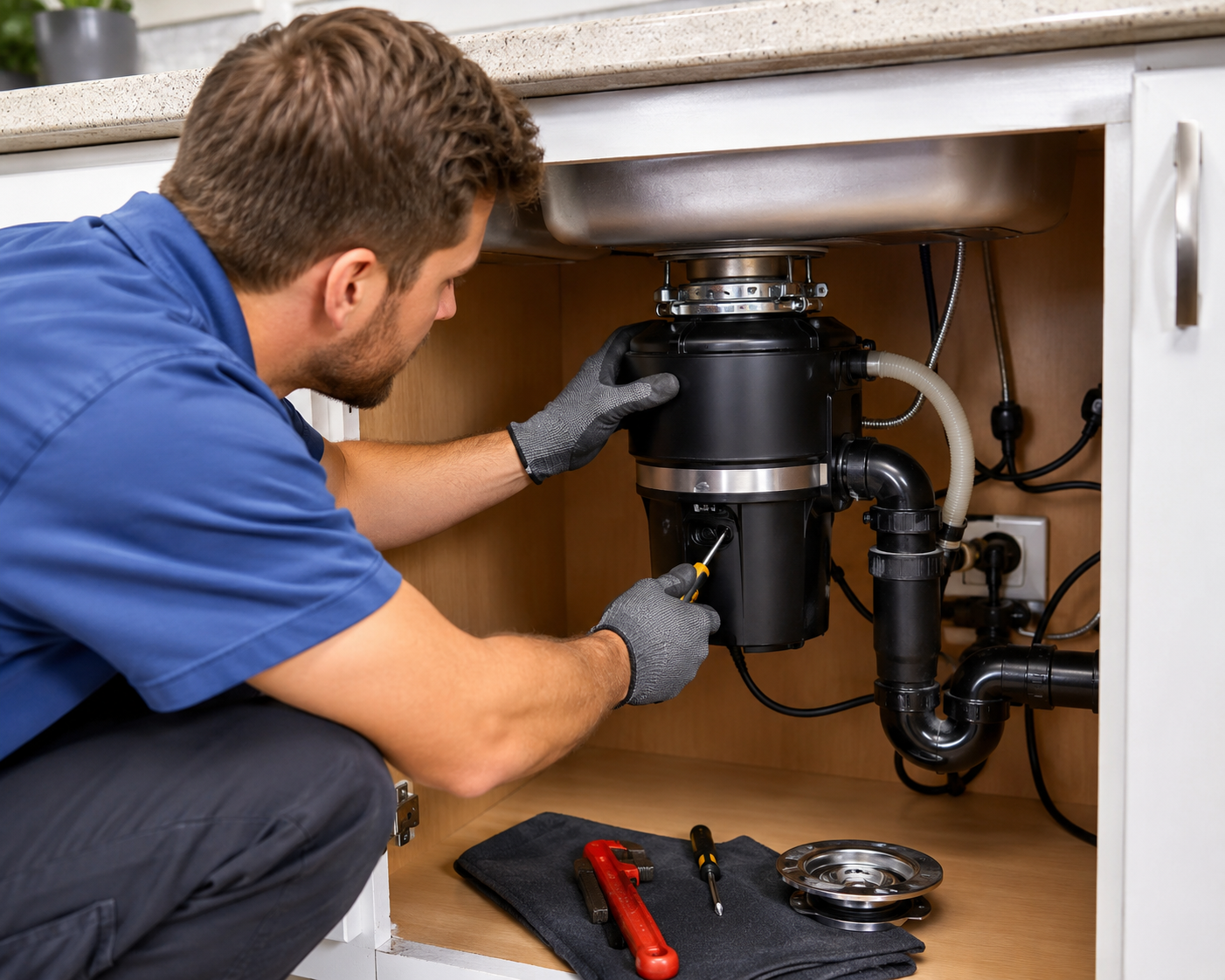
If your kitchen sink suddenly goes quiet except for an annoying hum, you’re not alone. Garbage disposal problems rank among the most common calls plumbers receive across the United States, and honestly, most of them come down to just a handful of causes. After years of working alongside licensed plumbers and researching current appliance repair standards, I’ve put together this guide to help you troubleshoot your unit safely before you spend money on a service call. Because sometimes, the fix takes five minutes. Other times, it genuinely needs a professional. Let’s break down how to tell the difference.
Why Your Garbage Disposal Stops Working in the First Place
Before jumping into fixes, it helps to understand what’s actually happening inside that metal canister under your sink. A garbage disposal is essentially a small motor connected to a spinning plate called a flywheel, which holds impellers (sometimes mistakenly called blades). When food, bones, or utensils get wedged between the impellers and the grinding ring, the motor either stalls or hums without turning.
Consequently, three general categories cause almost every disposal failure:
- Mechanical jams — something physical is blocking the flywheel
- Electrical issues — power isn’t reaching the motor properly, or a safety switch has tripped
- Motor failure — the unit has simply worn out and needs replacement
Since disposals typically last eight to twelve years with regular care, age matters too. If your unit is pushing a decade old and still causing trouble even after basic fixes, replacement is often more practical than repair.
The “Humming But Not Spinning” Problem, Explained
This is, by far, the most searched garbage disposal issue in 2026, and for good reason. It’s confusing because the unit clearly has power. You can hear it. Yet nothing moves.
In most cases, this happens because <cite index=”1-1″>the motor might be running while the blades are stuck, preventing the disposal from grinding food waste</cite>. Something has jammed the impellers, and the motor’s internal safety mechanism is trying to protect itself from burning out.
Here’s how to fix it, step by step:
- Turn off the power completely. Flip the wall switch and, if possible, the circuit breaker too. This isn’t optional — never work on a disposal that’s still connected to power.
- Look inside with a flashlight. Check for bones, fruit pits, silverware, or anything hard lodged near the impellers.
- Find the hex hole underneath the unit. Nearly every disposal, regardless of brand, has a small hexagonal opening on the bottom. Insert an Allen wrench (often included with the unit) and turn it firmly in both directions to manually rotate the flywheel and dislodge the jam.
- Remove debris with tongs, not your hand. Never reach into a disposal, even when it’s unplugged. A stuck flywheel can release suddenly.
- Press the reset button. It’s usually a small red button on the bottom of the unit. Push it firmly until it clicks.
- Restore power and test with cold water running. If the motor spins freely now, you’re done. If it still hums, move to the electrical checks below.
According to InSinkErator’s own manufacturer support documentation, this manual reset process using the included wrenchette is the standard first step for nearly every jammed or humming unit, regardless of model or age. You can review their official troubleshooting instructions on the InSinkErator support site for model-specific guidance.
When the Problem Is Electrical, Not Mechanical
Sometimes clearing a jam doesn’t solve anything, and that usually points toward an electrical cause instead. A few signs suggest this:
- The disposal doesn’t hum at all, and there’s total silence
- The reset button pops back out immediately after pressing it
- Lights flicker in the kitchen when you flip the switch
- A GFCI outlet under the sink has tripped
If you suspect a tripped outlet, check for a small “reset” button on the outlet itself, which is common throughout U.S. kitchens built after the mid-1990s due to updated electrical codes requiring GFCI protection near sinks. Press it, then test the disposal again.
If the breaker keeps tripping repeatedly, though, stop troubleshooting on your own. Repeated tripping usually signals a wiring short or a failing motor drawing too much current, and that’s a job for a licensed electrician or appliance repair technician rather than a DIY afternoon project.
Fixing a Leaking Garbage Disposal
Leaks are the second most common complaint, and they tend to show up in one of three spots.
Leaking from the top, near the sink flange, usually means the plumber’s putty seal has dried out or cracked over time. This is a fairly straightforward fix that involves removing the mounting assembly, cleaning the old putty away, and reapplying a fresh seal.
Leaking from the side typically points to a cracked internal seam, which unfortunately isn’t repairable. If your unit leaks from the housing itself, it’s time to replace it.
Leaking from the bottom, near the dishwasher or drain connections, is often caused by a loose hose clamp or a worn gasket where the discharge pipe connects. Tightening the clamp or replacing the gasket usually solves it.
If you’re uncertain where a leak is coming from, dry the unit completely, place a paper towel underneath, and run water briefly. The wet spot on the towel tells you exactly where to focus.
No Power at All? Check These First
When a disposal shows zero signs of life, work through this quick checklist before assuming the worst:
- Confirm the wall switch is actually turned on
- Check the reset button underneath the unit
- Test the outlet with another small appliance
- Inspect the breaker panel for a tripped switch
- Make sure the unit is plugged in securely, since vibration over time can loosen the connection
If everything checks out and there’s still no response, the motor has likely failed. At that point, replacement is your most realistic option.
Local Considerations That Actually Matter Across the U.S.
Where you live genuinely affects how your disposal ages and how you should approach repairs, so this isn’t just generic advice.
In hard water regions like Arizona, Texas, and much of the Midwest, mineral buildup accumulates faster inside the grinding chamber, which increases humming complaints. Running a vinegar-and-baking-soda cycle monthly helps offset this.
In humid, warm climates such as Florida, Louisiana, and the Gulf Coast, disposals face higher corrosion risk due to moisture exposure under the sink. Stainless steel components hold up noticeably better here than the cheaper galvanized units.
If you live in a building built before the 1960s, it’s worth checking your local plumbing code or co-op board rules before installing or replacing a unit.
Also worth noting: several states, including California, have pushed for more energy-efficient appliance standards in recent updates to building codes, so newer disposal models sold in 2026 tend to run quieter and draw less power than units from a decade ago. If you’re replacing rather than repairing, this is a good moment to upgrade.
Repair vs. Replace: How to Decide
This is where a lot of homeowners get stuck, understandably. Nobody wants to spend money unnecessarily, but nobody wants to keep pouring cash into a dying appliance either.
As a general rule, if your disposal is under five years old and the issue is a jam, clog, or minor electrical hiccup, repair almost always makes sense. If it’s closer to ten years old, or if you’re dealing with a cracked housing, persistent leaks, or a motor that won’t restart after multiple resets, replacement tends to be the smarter long-term move.
Cost is another factor. A basic reset or unjamming costs nothing but your time. A professional diagnostic visit typically runs somewhere between $100 and $250 depending on your region, while a full replacement, including labor, often lands between $200 and $600 for a mid-range unit. If a repair quote approaches half the cost of a new disposal, replacing it is usually the better financial decision.
For related plumbing maintenance around your kitchen, our complete guide to preventing kitchen sink clogs covers habits that also extend your disposal’s lifespan significantly.
Preventive Habits That Actually Reduce Repair Calls
Most disposal problems are preventable, honestly, and a few small habits go a long way.
Avoid fibrous foods like celery, corn husks, and onion skins, along with hard items like bones and fruit pits, all of which commonly cause jams. Run the disposal regularly, even when the sink is empty, because motors that sit unused for long stretches are more prone to seizing. Finally, skip chemical drain cleaners entirely, since they can corrode the internal components and actually shorten your disposal’s lifespan rather than help it.
When to Call a Professional
DIY troubleshooting handles the majority of jams, minor clogs, and simple resets just fine. However, certain situations genuinely call for a licensed plumber or appliance technician:
- The unit trips the breaker repeatedly, even after resetting
- You smell burning or notice scorch marks near the motor housing
- The disposal leaks from the housing itself, not just the seals
- Multiple resets fail to restore function
- You’re not comfortable working near electrical connections under a sink
There’s no shame in calling for help here. Electrical work involving water sources carries real risk, and a five-minute DIY attempt gone wrong can turn into a much costlier repair.
Frequently Asked Questions
Why is my garbage disposal humming but not spinning? This almost always means something is physically jamming the impellers while the motor still has power. Turning off the unit, using the hex wrench in the bottom hole to manually rotate the flywheel, and clearing any debris usually resolves it.
Is it safe to reach into my garbage disposal to remove a jam? No, never. Even when the power is off, always use tongs or pliers to remove debris. Use the reset button and hex wrench method instead of your hands, without exception.
How much does garbage disposal repair typically cost in 2026? Minor repairs like unjamming or resetting cost nothing if done yourself. Professional diagnostic visits generally range from $100 to $250, while a full replacement including labor often falls between $200 and $600 depending on your region and the unit’s features.
How long should a garbage disposal last before I need to replace it? Most units last between eight and twelve years with regular maintenance. If yours is approaching or past that range and experiencing repeated issues, replacement is usually more cost-effective than ongoing repairs.
Can I use chemical drain cleaners to fix a clogged disposal? It’s best to avoid them. Chemical cleaners can corrode internal components and gaskets, which shortens the unit’s lifespan considerably. Baking soda and vinegar, followed by cold water, is a safer alternative.
Why does my garbage disposal keep tripping the breaker? Frequent breaker trips usually point to an electrical short, a failing motor drawing excess current, or a wiring issue. This is one situation where calling a licensed electrician or appliance technician is genuinely the safer route.
Are all garbage disposals allowed in every U.S. city? Not necessarily. Some older cities, including parts of New York, restrict or prohibit disposal installation due to aging municipal sewer infrastructure. Always check local plumbing codes or your building’s regulations before installing one.
What’s the difference between a disposal jam and a motor failure? A jam typically produces a humming sound because the motor still has power but can’t turn. Motor failure usually means complete silence, with no humming or movement at all, even after resetting and clearing any visible debris.