

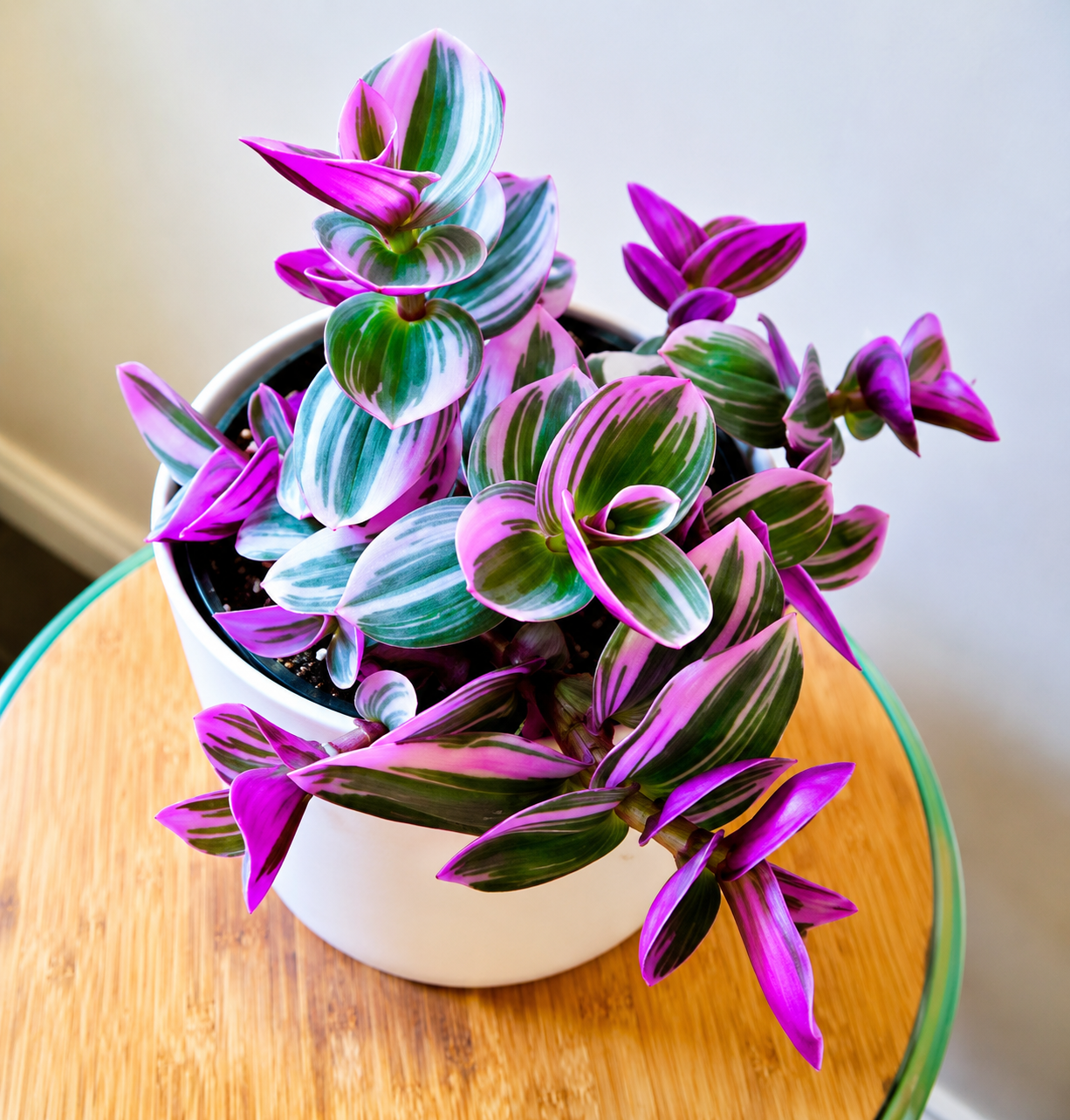
Few houseplants stop people mid-scroll the way Tradescantia Nanouk does.
Those thick, chunky leaves — banded in mint green, soft white, and vivid pink-purple — look almost too good to be real. And yet this plant is genuinely easy to grow. It forgives beginners, rewards attention, and practically propagates itself.
Whether you just bought your first Nanouk or you’ve had one struggling on a shelf for months, this guide covers everything you need to grow it well: light, water, soil, humidity, fertilizing, the right way to propagate it, and exactly what to do when things go wrong.
Let’s start with what this plant actually is.
What Is Tradescantia Nanouk?
Tradescantia Nanouk (full name: Tradescantia albiflora ‘Nanouk’) is a patented hybrid variety developed in the Netherlands through controlled cross-pollination of Tradescantia albiflora. It was bred specifically for its compact, bushy growth habit and intensely colorful foliage — two traits that made it an instant hit with the indoor plant community when it hit the market.
It belongs to the Commelinaceae family and is a close relative of the plants commonly called Wandering Jew or Wandering Dude (Tradescantia zebrina and T. fluminensis). The Nanouk stands apart from those cousins primarily through its unusually thick, rigid leaves and its color — a striking combination of bright green, white, and pink-to-purple striping on top, with a vivid purple underside.
The plant grows in a compact, upright-to-trailing habit and is considered a fast grower. During the active growing season of spring and summer, you can expect noticeable growth — sometimes more than two feet of new growth in a single month under ideal conditions.
It produces small white and yellow flowers that emerge from pink buds. They’re charming, though the foliage is the main event here.
One important note for US households with pets: Tradescantia Nanouk is mildly toxic to cats and dogs. It can cause skin irritation and digestive upset if ingested, according to the ASPCA. Keep it on a high shelf or in a hanging basket if you have curious animals at home.
Light: The Single Most Important Care Factor
If there’s one thing to get right with Tradescantia Nanouk, it’s light.
This plant’s extraordinary color — the pinks, purples, and greens that make it so visually distinctive — is directly dependent on how much bright light it receives. In low light, those colors fade. The plant becomes more green, the growth stretches and gets leggy, and it loses most of what makes it special.
What it needs: Bright, indirect light for at least 6 hours per day. Think the kind of light that’s bright enough to read comfortably without turning on a lamp, without direct sun hitting the leaves.
Best window placement in the USA:
- East-facing windows are ideal. Morning sun is gentle enough that it won’t scorch the leaves, and it delivers the bright light the plant craves for part of the day.
- South or west-facing windows work well too, provided the plant is positioned a few feet back from the glass or behind a sheer curtain to filter the more intense afternoon sun.
- North-facing windows typically don’t provide enough light to maintain the Nanouk’s vibrant color. If this is your only option, supplement with a full-spectrum LED grow light.
Signs your Nanouk needs more light:
- Stems becoming long, thin, and stretched between leaves (leggy growth)
- Colors fading from vivid pink-purple to mostly green
- Slow or stalled growth even during spring and summer
Signs of too much direct sun:
- Leaf edges turning brown or crispy
- Bleached, washed-out color on the top surface of leaves
- Curling leaves
One thing many growers don’t realize: rotating your Nanouk every couple of weeks helps it develop evenly. Plants naturally reach toward their light source, and without rotation, one side gets dense and colorful while the other goes leggy.
Watering: Getting the Balance Right
Overwatering is the number one killer of Tradescantia Nanouk. Not underwatering. Not pests and not low humidity. Water.
The plant’s thick, semi-succulent leaves store some moisture, which means it can tolerate a bit of drought. It cannot tolerate sitting in wet soil.
The rule: Water when the top 1 to 2 inches of soil feel dry to the touch. Stick your finger in — not just the surface, but down to your second knuckle. If it feels at all moist, wait.
How to water: Water thoroughly until it drains freely from the bottom of the pot, then discard any water sitting in the saucer. Never leave your Nanouk sitting in standing water.
Seasonal adjustments:
- Spring and summer (active growth): Water once or twice per week, always checking soil moisture first rather than following a fixed calendar schedule.
- Fall and winter (slower growth): Reduce to every 10 to 14 days, or whenever that top inch-plus is dry.
One thing most guides don’t mention: Tradescantia Nanouk has dense, clustered leaves that form crevices where water can pool if you water from above carelessly. Water sitting in those leaf crevices can cause rot at the base of the leaves. Try bottom watering — setting the pot in a shallow tray of water for 20 to 30 minutes — or simply take care to water at the soil level rather than pouring over the top of the plant.
Soil and Potting: What to Plant It In
Tradescantia Nanouk isn’t picky about soil, but it has one non-negotiable requirement: the mix must drain well.
A standard well-draining houseplant potting mix works fine. To improve drainage, many growers add perlite at a ratio of roughly 1 part perlite to 3 parts potting mix. This creates air pockets in the soil that prevent compaction and encourage roots to breathe.
Soil pH: The Nanouk prefers mildly acidic to neutral soil with a pH between 5.5 and 7. Standard potting mixes typically fall within this range.
Pots: Always use a pot with drainage holes. No exceptions. A beautiful pot without drainage will kill this plant slowly through root rot, no matter how carefully you water. If you love a decorative pot without holes, use it as a cachepot — place your Nanouk in a plain plastic nursery pot with holes inside the decorative one, and remove it to water.
When to repot: Every 1 to 2 years, or when you see roots growing out of the drainage holes or circling the top of the soil. Move up to a pot that’s 1 to 2 inches larger in diameter — not much bigger. Oversized pots hold more moisture than the roots can use, which increases the risk of root rot.
Temperature and Humidity
Tradescantia Nanouk is well-suited to typical American home conditions, which makes it a natural fit for most households.
Temperature: It thrives between 65°F and 80°F (18°C to 27°C) — which covers the average indoor temperature range in most US homes year-round. Keep it away from drafts, air conditioning vents, and exterior doors in winter. It’s cold-sensitive: temperatures below 50°F will stress the plant, and frost will kill it.
If you live in USDA Hardiness Zones 9 through 12 (Southern California, South Texas, Florida, the Gulf Coast), you can grow Tradescantia Nanouk outdoors in a sheltered spot. Everywhere else, it’s an indoor plant or a warm-season outdoor plant brought in before first frost.
Humidity: The Nanouk tolerates average household humidity (40% to 50%) reasonably well. It prefers slightly higher levels, and brown leaf tips are often a sign that indoor air — particularly in winter when central heating dries the air significantly — is too dry.
To boost humidity without misting (which can encourage fungal issues if the leaves stay wet):
- Set the pot on a pebble tray with water, keeping the pot above the waterline
- Place a small humidifier nearby
- Group it with other houseplants, which collectively raise local humidity
Fertilizing: Less Is More
Tradescantia Nanouk is not a heavy feeder, and one of the most common mistakes growers make is over-fertilizing.
The schedule: Feed with a balanced, water-soluble fertilizer (such as a 10-10-10 or 20-20-20 formula) once a month during the growing season — spring through summer. Dilute it to half the recommended strength to avoid burning the roots.
Fall and winter: Stop fertilizing entirely. The plant’s growth slows significantly in lower light and cooler temperatures, and fertilizing a resting plant can cause salt buildup in the soil and root damage.
One practical tip: If your Nanouk is in a fresh potting mix, it likely already has slow-release nutrients included. You may not need to fertilize at all in the first 3 to 4 months after repotting.
Signs of over-fertilization include brown leaf tips, a white crust on the soil surface (salt buildup), and wilting despite adequate watering. If you suspect salt buildup, flush the soil thoroughly with plain water several times to rinse it out.
Propagation: The Most Satisfying Thing About This Plant
Here’s where Tradescantia Nanouk really shines. It propagates so easily that once you have one healthy plant, you can have a dozen within a season — and sharing cuttings with friends is one of the genuine pleasures of growing this plant.
There are two main methods: water propagation and soil propagation. Both work well; the choice comes down to personal preference.
How to Take a Cutting
Regardless of which method you use, start the same way.
Use clean, sharp scissors or pruning shears — dirty or dull blades increase the risk of introducing bacteria at the cut site. Select a healthy stem with vivid leaves, at least 4 to 6 inches long, with no visible damage or pest activity.
Cut just below a node — the slightly raised bump or line on the stem where leaves emerge and where new roots will develop. Remove the lowest 1 to 2 inches of leaves so you have bare stem to work with.
Water Propagation
Fill a clear glass or jar with room-temperature water. Place the cutting so that at least one node — ideally two or three — is below the waterline. Make sure no leaves are submerged, as submerged leaves rot and contaminate the water.
Set the jar somewhere with bright, indirect light. Change the water every few days to keep it fresh and oxygenated.
Roots typically appear within 7 to 14 days. Once they’re about 1 to 2 inches long, the cutting is ready to move into soil. Transplant into a small pot with well-draining mix, water it in gently, and keep it in bright indirect light while it adjusts.
Pro tip: You can use a small amount of rooting hormone on the cut end before placing it in water to speed up root development, though the Nanouk roots eagerly enough that it’s rarely necessary.
Soil Propagation
Some growers prefer to skip the water phase entirely and propagate directly into soil. This avoids the transition shock that some cuttings experience when moving from water to soil.
Prepare a small pot with moist, well-draining potting mix. Make a small hole in the soil with a pencil or your finger, insert the stripped end of the cutting, and gently firm the soil around it.
Place the pot in bright indirect light and keep the soil consistently moist (but not waterlogged) for the first few weeks while roots establish. You can tent a clear plastic bag loosely over the cutting to retain humidity and encourage rooting.
Roots typically establish within 2 to 4 weeks. You’ll know they’ve taken hold when the cutting resists a gentle tug and shows signs of new growth.
Propagating to Rejuvenate a Leggy Plant
One of the best things you can do for an overgrown or leggy Nanouk is use the pruned stems as cuttings. Trim back the long, stretched stems, poke several cuttings directly back into the soil around the edges of the same pot, and they’ll root in place — filling out the plant and giving it a fresh, bushy appearance within a few weeks.
Pruning and Maintenance
Regular pruning keeps your Tradescantia Nanouk full, bushy, and vibrant. Without it, the plant tends to trail and thin out at the top over time.
Pinch or cut off the growing tips every few weeks during the active season to encourage branching. Each pinched tip responds by sending out two or more new shoots from the nodes just below the cut — this is how you build a dense, full plant rather than a long, trailing one.
Don’t throw those pinched tips away. Each one is a potential new plant.
Common Problems and How to Fix Them
Leggy, Stretched Growth
Cause: Not enough light. This is the most common complaint among Nanouk owners.
Fix: Move the plant closer to a bright window, or add a full-spectrum LED grow light. Prune back the leggy stems and propagate them — the pruning encourages fresh, compact new growth from the base.
Fading Color (Loss of Pink and Purple)
Cause: Insufficient light. The vivid colors in Tradescantia Nanouk are produced by anthocyanin pigments that the plant develops in response to bright light. Low light means less pigment.
Fix: More light, immediately. Move to a brighter spot and the color will recover within a few weeks.
Yellow Leaves
Cause: Most commonly overwatering or root rot. Less commonly, underwatering, natural aging of lower leaves, or nutrient deficiency.
Fix: Check the soil. If it’s wet and the roots look brown or mushy rather than white and firm, you have root rot. Remove the plant from its pot, cut away any damaged roots with clean scissors, let the roots air dry for a few hours, and repot in fresh dry soil. Lay off watering for a week.
If only lower, older leaves are yellowing while the rest of the plant looks healthy, it’s likely just natural leaf turnover — nothing to worry about.
Brown Leaf Tips
Cause: Low humidity, salt buildup from over-fertilizing, or irregular watering.
Fix: Raise humidity with a pebble tray or humidifier. If salt buildup is suspected, flush the soil with plain water. Ensure your watering is consistent rather than alternating between very wet and bone dry.
Root Rot
Cause: Overwatering, poor drainage, or a pot without drainage holes.
Fix: Act quickly. Remove the plant from its pot, cut away all soft or brown roots, treat the remaining healthy roots with a light dusting of cinnamon (a natural antifungal) or a diluted hydrogen peroxide solution, and repot in fresh, dry, well-draining soil. Hold off watering for a week and place in bright indirect light to help it recover.
Spider Mites
Cause: Dry indoor air, particularly in winter when central heating is running. Spider mites thrive in hot, dry conditions.
Signs: Fine webbing on the undersides of leaves, tiny moving specks, leaves looking stippled or dusty.
Fix: Isolate the plant immediately. Wipe down the leaves with a damp cloth, then treat with neem oil or insecticidal soap spray, making sure to coat the undersides of leaves where mites congregate. Repeat every 5 to 7 days for 3 weeks to break the pest cycle. Our Kimberly Fern guide covers the same treatment approach if spider mites show up on other houseplants too.
Mealybugs
Signs: White cottony clusters in leaf joints and along stems.
Fix: Isolate the plant. Remove visible mealybugs with a cotton swab dipped in rubbing alcohol. Follow up with neem oil spray every week for a month.
Aphids
Signs: Clusters of small green, white, or black insects on new growth and stems; sticky residue (honeydew) on leaves.
Fix: A strong stream of water knocks aphids off effectively. Follow up with insecticidal soap spray. Repeat weekly until resolved.
Quick Care Reference
| Care Factor | What It Needs |
|---|---|
| Light | Bright indirect light, 6+ hours daily |
| Water | When top 1–2 inches of soil are dry |
| Soil | Well-draining mix; add perlite for extra drainage |
| Temperature | 65°F to 80°F (18°C to 27°C) |
| Humidity | Average to moderate; higher is better |
| Fertilizer | Balanced liquid fertilizer, monthly, spring–summer only |
| Repotting | Every 1–2 years; 1–2 inches larger pot |
| Propagation | Stem cuttings in water or soil; roots in 7–21 days |
| Toxicity | Mildly toxic to cats and dogs (ASPCA) |
| Growth rate | Fast; 2+ feet per month in ideal spring/summer conditions |
Frequently Asked Questions
Why is my Tradescantia Nanouk losing its pink color? Almost always a light issue. Move it closer to a bright window or add a grow light. The pink and purple pigments return within a few weeks once light levels improve.
How often should I water my Nanouk? Don’t go by a calendar. Water when the top 1 to 2 inches of soil are dry to the touch. In summer that might be twice a week; in winter it might be once every 10 days. The soil tells you when, not the date.
Can Tradescantia Nanouk grow in water permanently? Yes, it can survive in water indefinitely, though it grows more slowly and less vigorously than in soil. Change the water every few days to keep it fresh.
Is Tradescantia Nanouk pet-safe? No. It’s mildly toxic to cats and dogs and can cause skin irritation and stomach upset if ingested. For authoritative guidance on houseplant toxicity, the ASPCA Animal Poison Control database is the most trusted and up-to-date resource for US pet owners.
How do I make my Nanouk bushier? Pinch off the growing tips regularly and propagate those cuttings back into the same pot. More light also helps — a plant in bright indirect light stays compact and full, while a plant in low light stretches and thins out.
Final Thoughts
Tradescantia Nanouk is one of those rare plants that delivers on its Instagram promise in real life.
It’s genuinely easy to care for. It grows fast. It propagates freely. And when it’s getting the right light, those colors — the pinks, the purples, the creamy greens — are as vivid and striking as any houseplant you’ll find.
The one thing that trips most growers up is overwatering. Get that right, give it a bright spot, and the Nanouk will reward you with lush, colorful growth that makes it one of the most satisfying plants you can grow indoors.
If you’re just starting out, our Philodendron Brasil care guide and Angel Wing Begonia guide cover two other easy, colorful houseplants that pair beautifully with your Nanouk.
[…] If you’re in a major U.S. city, you’ll find quality lucky bamboo at Asian supermarkets, specialty garden centers, and online retailers like Lively Root and The Sill, both of which ship live plants with detailed care instructions included. For another low-maintenance, easy-to-grow houseplant, see our Tradescantia Nanouk care guide. […]