

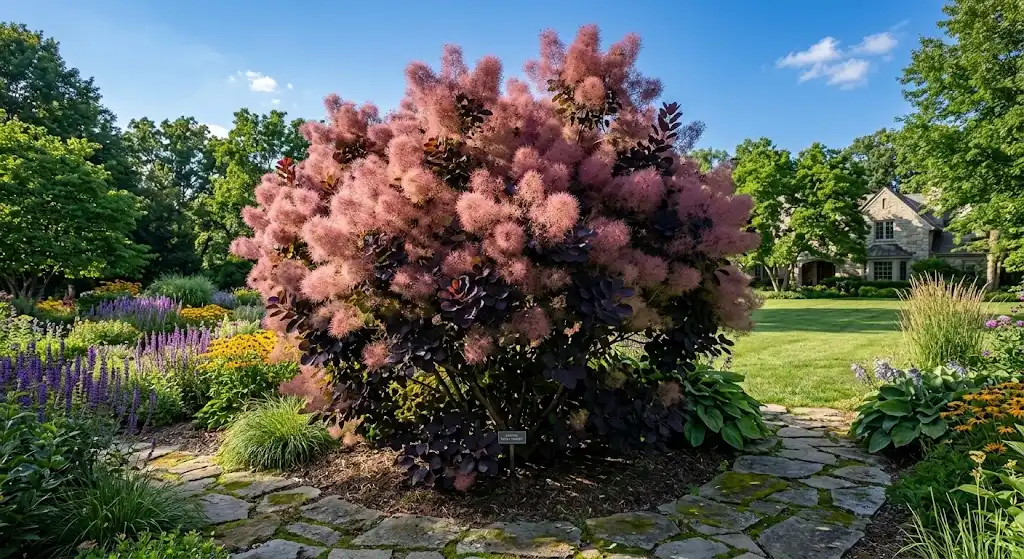
Pick a purple common smokebush if you want the cloud of summer smoke, and the American smoketree if fall color matters more. Either way, Cotinus shrubs need full sun and soil that drains, and very little else. They grow quickly, and deer tend to leave them alone. One soil fungus can still kill them, though, and that risk shapes most of the advice below.
Which Cotinus shrubs are worth buying
Two species turn up in gardens. The common smokebush (Cotinus coggygria) comes from southern Europe to central China and reaches 10 to 15 feet tall and wide at a rapid pace. The American smoketree (Cotinus obovatus) is a native of rocky soils from Kentucky and Tennessee through northern Alabama to Oklahoma, with a pocket in central Texas. It grows to about 25 feet as a small tree.
The “smoke” is a trick of anatomy. The real flowers are tiny and yellow, and easy to miss. What you see from midsummer are pink hairs on the flower stalks, in panicles 6 to 8 inches long.
Here is how the plants you will actually find for sale compare:
| Plant | Leaves | Worth knowing |
|---|---|---|
| ‘Royal Purple’ | Very dark purple, almost black | Showy purple plumes; among the denser cultivars |
| ‘Golden Spirit’ | Bright yellow all season | Reaches about 12 feet; the brightest of the group |
| ‘Daydream’ | Green | Brownish pink plumes; slower growing and dense |
| ‘Grace’ | Red purple in spring, blue green later | A hybrid of ‘Velvet Cloak’ and American smoketree, with very large pink purple plumes |
| ‘Cotton Candy’ (American) | Blue green | Pink smoke, red and orange fall color, hardy to zone 3 |
Virginia Tech’s extension sheet lists ‘Daydream’ and ‘Royal Purple’ among the naturally denser cultivars, which matters because the straggly habit is the species’ main flaw.
If you want one pick, ‘Royal Purple’ is the safe answer for smoke and contrast. But the American smoketree deserves more shelves than it gets. The University of Arkansas extension quotes Georgia horticulturist Michael Dirr as calling it perhaps the best fall color tree in the South and Midwest. Its plumes are smaller than the common smokebush, and Virginia Tech notes that it is generally not sold in garden centers, so expect to order by mail.
Where to plant a smoke bush, and what the roots want
Sun comes first, and it decides leaf color as well as vigor. NC State Extension lists six or more hours of direct sun as the requirement, and warns that purple-leaved varieties in shade may revert to green. Shaded plants also grow lanky.
Soil matters less than you would think. The same source lists clay, sand and shallow rocky soil, from acid to alkaline, as acceptable. What it will not forgive is wet feet: overly wet conditions lead to root rot. If your yard holds water after rain, pick a drier spot or a different shrub.
Plant in spring or early fall so the roots settle before extreme heat or cold. Dig a hole about twice the size of the root ball and set the plant at ground level, not deeper. The fibrous root system makes smoke bushes easy to transplant, and once established they are drought tolerant.
Give them room. A mature common smokebush spreads 10 to 15 feet, so a row of them makes a loose informal hedge, never a clipped one.
One safety note: smoke bushes belong to the same family as poison ivy, and contact with the sap can cause dermatitis in sensitive people. Wear gloves and long sleeves when you prune.
Prune for smoke or prune for shape, because you rarely get both
A smoke bush left alone looks fine for a while. Then it sends up long stems and turns straggly. Cut it hard and you get a fuller plant, though you lose the show for a season, and that trade is the whole pruning question.
NC State advises cutting back to 6 to 8 inches above the ground in late winter to rejuvenate the shape. That sacrifices flowering for the year, so to keep the smoke, leave about a third of the old stems in place.
Virginia Tech suggests pruning a shrub-form plant near ground level for its first two years to build a dense, many-stemmed base. Gardeners’ World adds that hard cuts in early spring bring larger leaves than average.
So the choice follows the cultivar. If you bought ‘Royal Purple’ or ‘Golden Spirit’ for leaf color, cut it back every year and enjoy the bigger leaves. If you bought a plant for its plumes, thin it lightly and leave the framework alone. For a small tree instead of a shrub, pick one or more main trunks early and prune toward that shape.
Remove shoots that creep along the ground at the base if you do not want the plant to spread.
Verticillium wilt, the problem plant tags skip
NC State’s page tags the plant as pest and disease resistant. The same page admits some susceptibility to Verticillium wilt, along with rust and leaf spot. The University of Florida is blunter: smoketree is very susceptible, and entire branches wilt and die.
The pathogen lives in the soil and enters through the roots. UMass Extension names smoketree among the most common hosts in gardens, next to maple, elm and redbud. Its photo of an infected smoketree shows diffuse browning of the leaves and dark staining inside the stems.
Look-alikes exist. The University of Kentucky warns that appearance alone cannot confirm the disease and that a lab must isolate the fungus from discolored wood, which your county Extension office can arrange. Kentucky also says the disease cannot be cured, though good care may prolong the life of a plant with mild symptoms.
So prevention happens at planting. Do not put a Cotinus where a maple or redbud recently declined. If a smoke bush dies of wilt, do not replant Cotinus in the same spot. UMass notes that replacing infected plants with resistant species is often the only workable strategy.
The American smoketree looks better here. The Morton Arboretum reports no common problems for it. That is one fair reason to go to the trouble of ordering one by mail.
Before you buy
Stake the spot you have in mind and check it at three points in one day, counting the hours of direct sun. Look for standing water after the next rain.
Then think back: did a maple or redbud fail there? If the spot passes, order for spring planting and choose by what you want most. Choose ‘Royal Purple’ for dark foliage and purple smoke, or an American smoketree if October color is the goal.
Sources
- NC State Extension: Cotinus coggygria
- NC State Extension: Cotinus obovatus
- Virginia Cooperative Extension: Smokebush, Smoketree
- UMass Extension: Verticillium wilt
- University of Kentucky: Verticillium Wilt of Woody Plants
- UF/IFAS: Cotinus coggygria ‘Daydream’
- University of Arkansas Extension: Chittamwood
- The Morton Arboretum: American smoke tree
- Gardeners’ World: How to grow smoke bush
- GrowVeg: Smoke Bush Growing Guide
- Plantura: Smoke bush
- Plant Detectives: The Smokebush Guide
- Hicks Nurseries: Golden Spirit Smokebush