

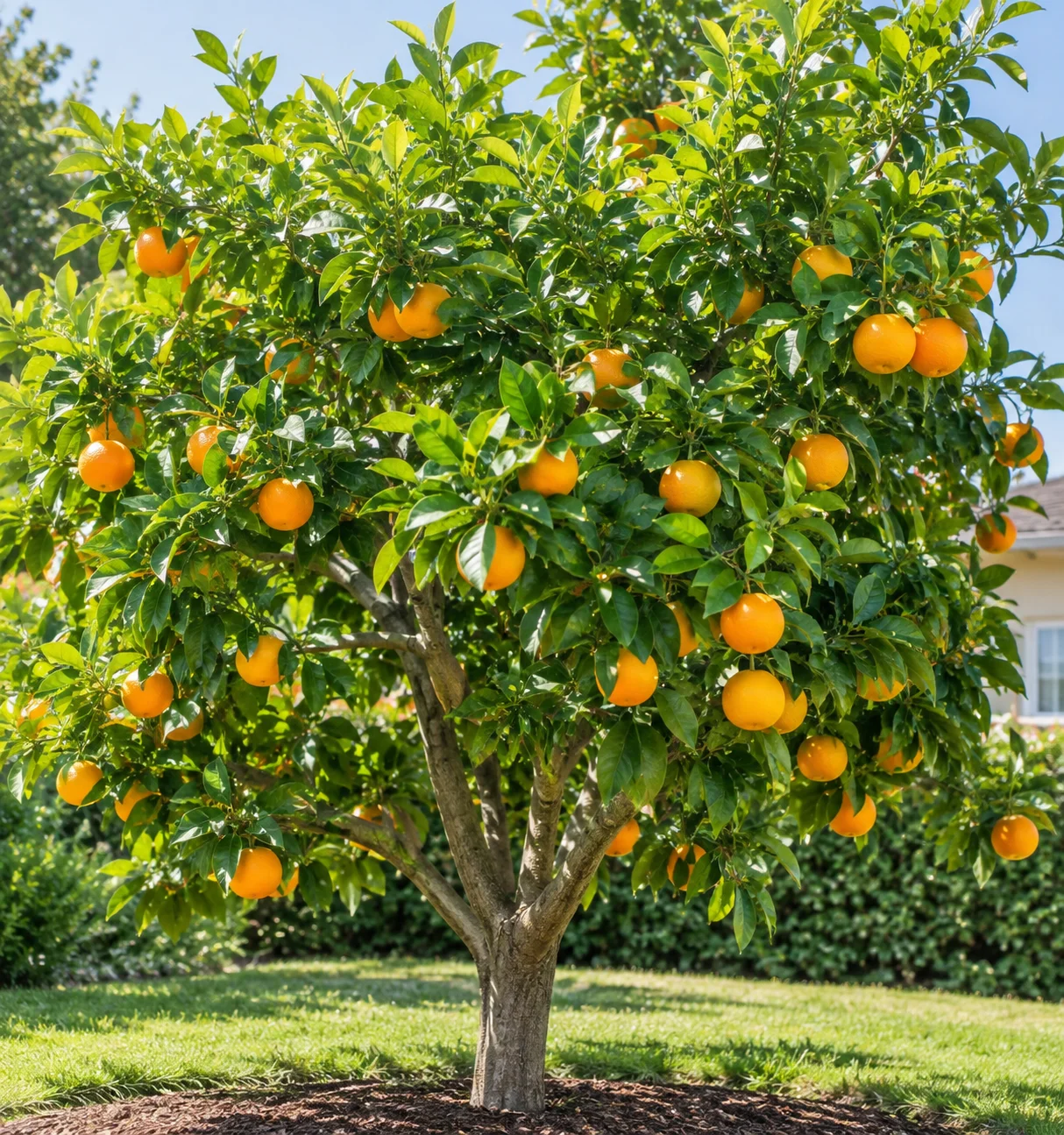
A healthy orange tree needs six to eight hours of sun, soil that drains well, deep but infrequent watering and regular feeding with a fertilizer made for citrus. It also needs protection from hard freezes. Most of the work happens in the first two or three years. After that, an orange tree is one of the more forgiving fruit trees you can grow, as long as your climate allows it.
Climate is the first question because it decides everything else. Sweet oranges grow best outdoors in USDA zones 9 through 11, which cover much of Florida, the Gulf Coast, southern Texas, the desert Southwest and California’s warmer valleys and coast. People who live in colder zones can still grow oranges in containers and bring them inside for the winter. If you are weighing other warm-zone fruit trees, our Hass avocado tree guide covers similar climate questions.
Is your location right for oranges?
Oranges only thrive where winters are mild. Established trees can generally tolerate brief dips to around 28 degrees Fahrenheit, but a few hours at 28°F or lower can damage the fruit. Longer or harder freezes can injure branches and even kill the whole tree. Young trees are more vulnerable than mature ones. These are general rules: the actual outcome depends on how long the cold lasts, how dry the air is and whether the tree was well fed and watered beforehand.
Rough guidance by region:
- Florida, Gulf Coast, South Texas: Warm enough for in-ground trees, though you will still face occasional freezes. Citrus greening disease is also a serious concern (more on that below).
- Arizona: Oranges do well in the warmer low-desert areas. Small differences in the landscape matter, because cold air settles in low spots. Intense inland desert heat can also burn the bark and damage the fruit.
- Georgia, the Carolinas and the Gulf South north of the citrus belt: This area is borderline. Oranges will only work if you have a protected spot, like a south-facing wall. Without that it’s risky.
- Everywhere else: Grow your orange tree in a container, and bring it inside or into a greenhouse from fall until spring.
If you are in a borderline zone and want something tougher, try satsuma mandarins. They handle cold better than sweet oranges, which is why they are often recommended in the Gulf South. They are not oranges, but they give you a similar kind of fruit.
Choosing a variety
Don’t just grab whatever is at the big-box store. Variety affects when you harvest, how the fruit tastes, and how well the tree handles your climate.
| Variety | Best for | Typical harvest window* | Notes |
|---|---|---|---|
| Washington navel | Fresh eating | Late fall to winter | Seedless, easy to peel; likes warm days and cooler nights |
| Cara Cara | Fresh eating | Winter | Pinkish flesh, low acidity; a navel type |
| Valencia | Juice | Late winter through summer | Holds fruit on the tree for months; the standard juice orange |
| Hamlin | Early juice | Fall to early winter | Common in Florida; fruit tends to be less flavorful than Valencia |
| Moro (blood orange) | Color and flavor | Winter | Deep red color develops best with cool nights |
| Trovita | Hotter inland areas | Spring | Tends to handle heat reasonably well |
*Timing shifts by region and year. Think of these as estimates, not guarantees.
If your main goal is juice, Valencia is hard to beat because the fruit holds on the tree for months. If you want something to peel and eat at the kitchen counter, a navel is the simple choice. Dwarf versions of most of these varieties work well for small yards and containers.
About HLB (citrus greening): This bacterial disease has devastated Florida citrus and is now present in other states, including Texas, Louisiana, Georgia, South Carolina and parts of Southern California. There is no cure. If you live in or near an affected area, University of Florida researchers advise home growers to look for varieties with some tolerance. They currently recommend Sugar Belle mandarin and the OLL-4 and OLL-8 sweet oranges, which are available through participating nurseries. UF/IFAS also suggests covering trees with insect screening and checking regularly for the Asian citrus psyllid, the insect that spreads the disease. Their Home Citrus program is the best place to check current guidance.
Where to buy, and a legal note
Buy a grafted tree from a licensed nursery, not a seedling. Grafted trees usually produce fruit within two to three years. A tree grown from a grocery store seed may take a decade or more, and the fruit often isn’t like the parent.
Also, don’t move citrus plants, cuttings, or fruit across state lines or out of quarantine zones without checking the rules. Many states restrict this to slow the spread of citrus pests and diseases, and California has quarantine areas with specific rules. Check your state department of agriculture before ordering online.
When you pick a tree, look for a clean, straight trunk with a visible graft union (a slight bend or bulge a few inches above the soil), glossy leaves without curling or stippling, and roots that aren’t circling hard around the pot.
How to plant an orange tree
When: In mild climates, spring is ideal because the tree has a full season to establish before any cold. In frost-free areas, fall planting can work too. Avoid planting just before a heat wave or a freeze.
Where: Pick the sunniest spot you have, with at least six to eight hours of direct sun. The site needs good drainage; in heavy soil or rainy regions, planting on a slight mound helps keep roots out of standing water. Leave room. Even a modest tree can reach 12 to 25 feet wide depending on the variety and rootstock, and trees planted too close to a house or fence become a pruning headache. Dwarf trees can go in as little as 8 to 10 feet apart.
Steps:
- Dig a hole about as deep as the root ball and two to three times as wide. Loosen the sides so roots can push out.
- Gently tease out any circling roots.
- Set the tree so the top of the root ball sits level with or slightly above the surrounding soil. Never bury the graft union. Planting too deep is one of the most common causes of trunk rot and slow decline.
- Backfill with the native soil. Heavy amendments tend to create a “bathtub” effect where water collects in the softer soil.
- Build a shallow basin and water thoroughly.
- Mulch two to three inches deep, pulled back several inches from the trunk so the bark stays dry.
Watering
Young trees need regular watering for the first few months while roots establish, often a few times a week at first, tapering off as the weather and the tree allow. Once established, oranges do better with deep, infrequent watering than with frequent shallow sprinkling. Overwatering stresses them about as much as drought does, particularly in poorly drained soil.
Some practical signals:
- Leaves that curl and droop in the afternoon but recover overnight usually mean the tree wants water soon.
- Yellowing leaves combined with soggy soil point toward too much water.
- In the desert Southwest, expect to water more often in summer, and let the water reach the whole root zone, not just the trunk base.
- In rainy regions like the Gulf Coast, drainage matters more than irrigation.
Fertilizing
Oranges are hungry trees, especially for nitrogen, and they also need micronutrients such as zinc, manganese, and iron. A fertilizer labeled for citrus covers these. Spread it under the canopy, not against the trunk, and follow the label rates for your tree’s age, since the right amount increases as the tree grows. Splitting the feeding into several lighter applications from spring through summer is generally better than one heavy dose.
Yellow leaves with green veins often signal a micronutrient problem rather than a lack of nitrogen. Before you keep adding fertilizer, rule out waterlogged roots and cold damage. Your county’s Cooperative Extension office can advise on soil testing, and in some places they’ll do it for a small fee or for free.
Pruning and trunk care
Oranges need less pruning than apples or peaches. Keep it simple:
- Remove dead, damaged, or crossing branches.
- Remove suckers growing from below the graft union. They come from the rootstock and won’t produce the fruit you want.
- Thin the canopy lightly if it gets so dense that sunlight can’t reach the interior.
Avoid heavy pruning. The leaves are the tree’s food factory, and the canopy also shades the bark. In hot, sunny climates, unshaded bark can sunburn, so some growers paint young trunks with diluted white interior latex paint or use a trunk wrap.
Common problems
- Leaf miner: Squiggly silvery trails in new leaves. It looks alarming but rarely hurts mature trees. It matters more on young ones.
- Aphids and scale: Sticky leaves and sooty black mold often trace back to sap-feeding insects. A strong water spray or horticultural oil handles many cases. Check local extension advice before using stronger products.
- Asian citrus psyllid: Small, hard-to-spot insects feeding on new growth. In areas with HLB, this is the pest that matters most.
- Gummosis or foot rot: Oozing gum at the trunk base, usually tied to wet soil and a buried graft union.
- Fruit drop: Some drop in late spring or early summer is normal. A tree sets far more fruit than it can carry. Heavy drop outside that window usually points to water stress or temperature extremes.
- Frost damage: Water well before a forecast freeze, since moist soil holds heat better. Cover young trees with frost cloth draped to the ground, and consider a string of old-style incandescent lights (not LEDs) under the cover for a bit of warmth. Don’t prune freeze-damaged branches right away. Wait until new growth shows you what survived. For more cold-season prep, see our guide to winterizing your garden.
Growing oranges in containers
Containers make oranges possible well outside zones 9 to 11, but they come with trade-offs. Use a dwarf or semi-dwarf tree, a pot with large drainage holes (start around 15 gallons for a mature dwarf), and a fast-draining potting mix, not garden soil.
Containers dry out faster, so check moisture often in summer. They also need feeding more regularly because nutrients wash out with watering. Move the pot outdoors once nights are reliably warm, and bring it in before temperatures approach freezing. Indoors, the biggest limit is light: put it in your sunniest south-facing window or under a strong grow light, or it will drop leaves and sulk.
Expect fewer fruits than an in-ground tree would give you, and fewer in the first couple of years.
When your oranges are actually ready
Oranges don’t ripen after they’re picked, so timing matters. Taste is a better guide than color.
In warm, humid climates, fruit can stay green or turn from orange back to green while fully sweet, so color misleads. Pick one fruit, taste it, and wait a week or two if it’s tart. Fruit left on the tree usually keeps improving for a while, and many varieties hold well for weeks.
Some practical tips:
- Twist or clip the fruit with a short stem; yanking can tear the peel and the branch.
- Navels are often ready in late fall to winter; Valencias are often a late-winter through summer fruit.
- Fruit stores for a few weeks in a cool spot, and longer in the refrigerator.
- Don’t expect a big first crop. A young tree may give just a handful of fruits, and it’s generally wise to pick off most fruit in the first year or two so the tree puts energy into roots and branches.
Quick-start summary
If you are starting from scratch, the sensible approach is straightforward. Choose a grafted tree of a variety suited to your region and goal: a navel for eating, a Valencia for juice, or a more tolerant variety if you live in an HLB area. Plant it in the sunniest, best-drained spot, set it slightly high and keep mulch off the trunk. Water deeply but not constantly. In a marginal climate, skip the in-ground gamble and use a container, since a protected pot is easier to save than a frozen 10-foot tree.
Frequently asked questions
How long does it take an orange tree to bear fruit?
A grafted nursery tree commonly gives a light first crop in two to three years, with heavier yields as it matures. Seed-grown trees can take much longer and may produce inferior fruit.
Can I grow an orange tree in a cold climate?
Only in a container that you protect from freezing. Keep it in a bright location through winter, and expect fewer fruit than in a warm climate.
Why are my orange tree’s leaves turning yellow?
The most common causes are overwatering or poor drainage, a nutrient deficiency (especially nitrogen or micronutrients), and cold stress. Check the soil moisture first, then your feeding schedule. Persistent blotchy yellowing in an HLB area deserves a call to your extension office.
Do I need two orange trees for pollination?
No. Sweet oranges are self-fertile, so a single tree will set fruit.
When is the best time to plant an orange tree?
Spring in most mild climates, giving the tree a full warm season to establish. In frost-free areas, early fall can also work.
How much sun does an orange tree need?
At least six to eight hours of direct sun daily. Trees tolerate light shade but fruit less.
Why does my tree drop so much fruit?
Some drop in late spring is normal. Excessive drop usually signals inconsistent watering, extreme heat, or nutrient problems.
Are oranges from my own tree really better than store-bought?
They can be, because home fruit can ripen fully on the tree instead of being picked early for shipping. Still, flavor depends on variety, climate, and care, so it isn’t guaranteed.
Related reading
For more fruit tree guidance, see our pear tree care guide. For another warm-climate fruit tree, see our Hass avocado tree guide. Before the first frost, read how to winterize your garden.
Sources & references
- UF/IFAS Home Citrus program: homecitrus.ifas.ufl.edu
- UF/IFAS Extension publication “Citrus Culture in the Home Landscape” (Rouse and Zekri), available through the UF/IFAS EDIS library
- UF/IFAS Extension Hillsborough County, “Growing Citrus in the Florida Home Landscape” (May 2026)
- Your state department of agriculture and local Cooperative Extension office for quarantine rules and regional guidance