

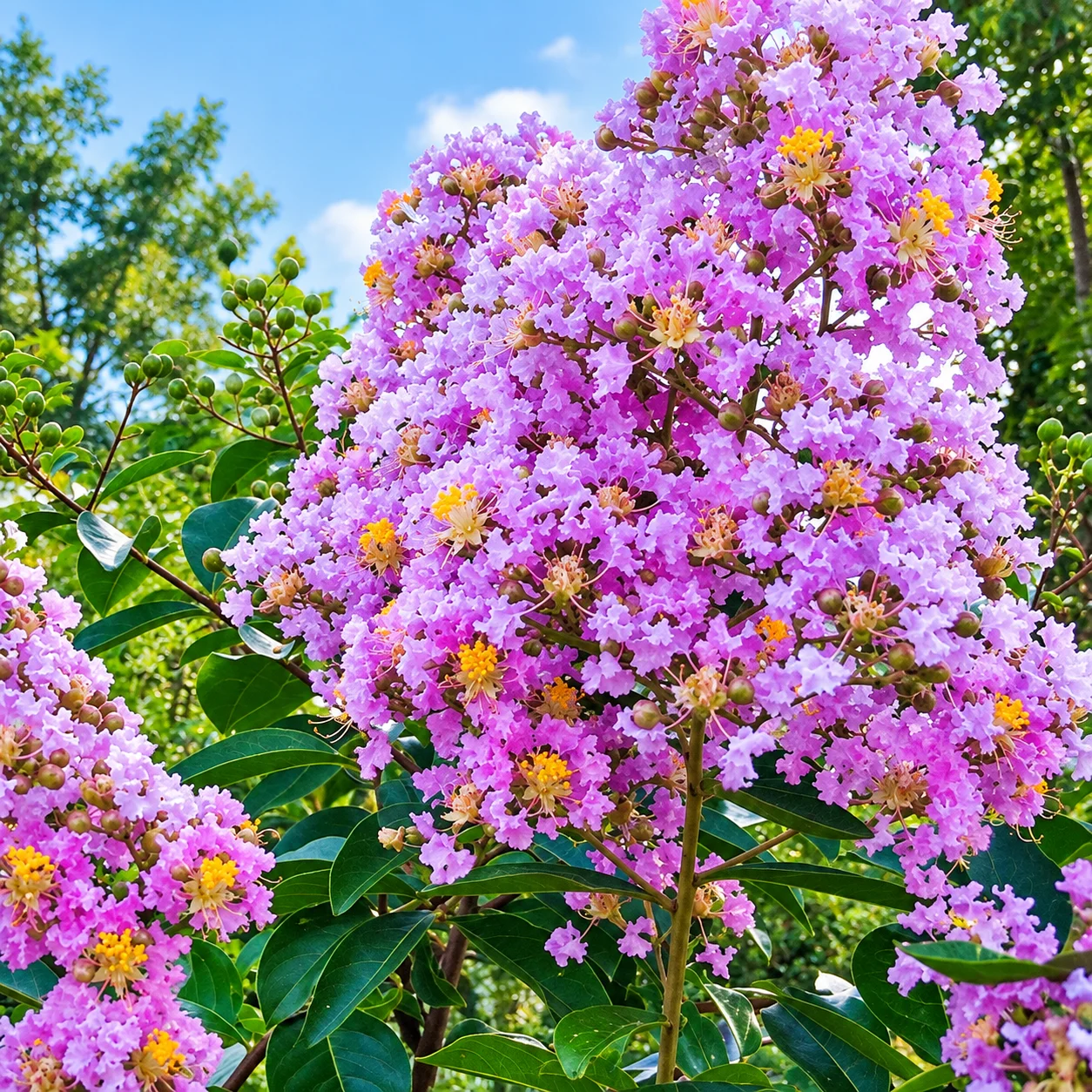
Muskogee is a fast-growing crape myrtle that features light lavender-pink flowers and peeling gray-tan bark. It has resistance to powdery mildew, which makes it a low-maintenance choice for many gardens. This plant does best in USDA zones 7 through 9. It can grow into a tree reaching heights of 20 to 25 feet and sometimes even taller. If your yard has plenty of space, Muskogee is a great option. If you’re looking for a compact shrub for a front walkway, it’s not the right choice.
The details below will help you decide if Muskogee fits your yard and how to keep it healthy.
Quick facts
| Trait | Typical range |
|---|---|
| Botanical name | Lagerstroemia indica × fauriei ‘Muskogee’ |
| Origin | Hybrid released by the U.S. National Arboretum |
| Mature height | About 15–25 ft in most sources; up to 30 ft in some |
| Mature spread | About 10–20 ft, sometimes wider |
| Bloom color | Light lavender to lavender-pink |
| Bloom season | Summer into early fall |
| Hardiness | Zones 7–9 (some sources say 6–10) |
| Sun | Full sun |
| Mildew resistance | High |
Published size numbers can vary quite a bit. The Missouri Botanical Garden, Clemson Extension, nurseries and the University of Florida’s IFAS program all give different ranges. That’s normal for a plant whose final size depends on climate, soil, water, and how it’s pruned. Plan for the upper end of the range because Muskogee is known for growing fast and filling out.
How big does Muskogee crape myrtle get?
Most references say Muskogee is 20 to 25 feet tall and has a spread of 15 feet or so. The University of Florida says it is a vase-shaped tree of about that size and it does well as a street tree. Some nurseries say it can get up to 30 feet tall in long hot growing seasons. One Southern grower says it can reach 30 feet in 15 to 20 years.
Growth speed is one of Muskogee’s best features. Extension sources say it grows about a foot or two each season. Compared with dwarf and semi-dwarf varieties, that means shade and screening come sooner.
That vigor works both ways. It’s a great shade-and-flower tree for a larger lot, but it’s a poor choice for:
- A planting bed 3 feet from the house foundation
- The area under overhead power lines
- A narrow side yard where you’d need to prune it hard every year
If you have limited space, a smaller cultivar will save you years of fighting the plant’s natural size.
Bloom color and season
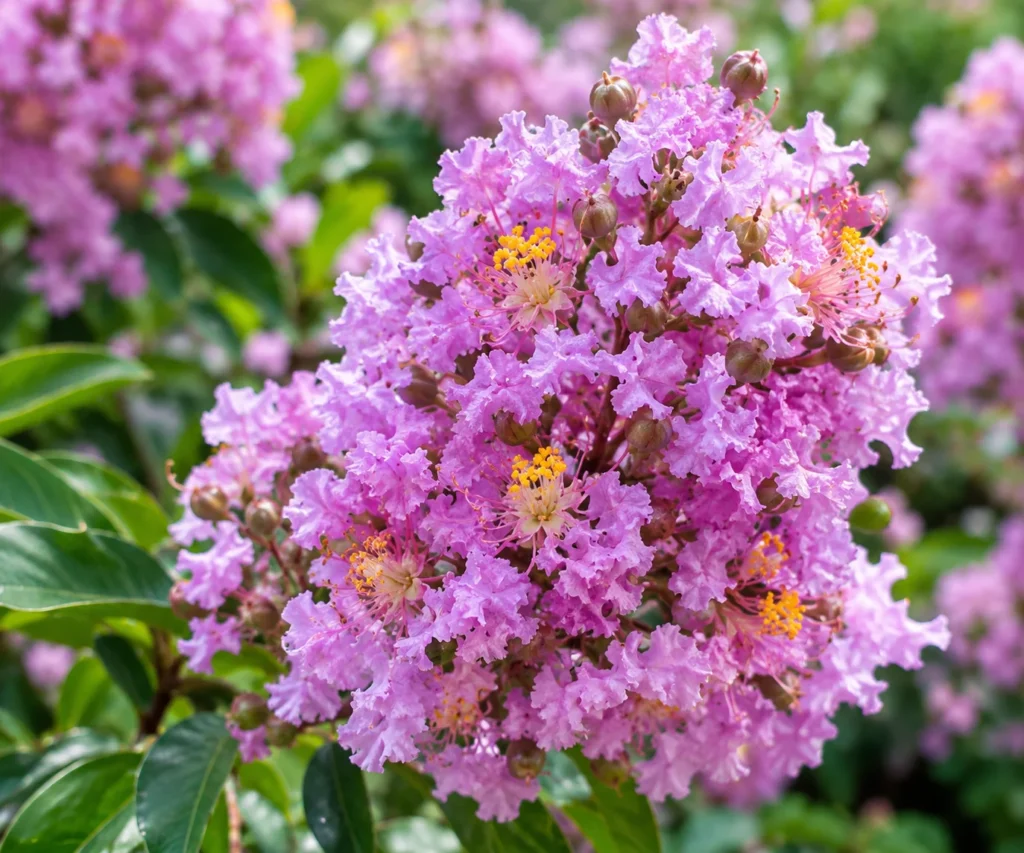
The flowers are a pale lavender with a hint of pink. Depending on the light and the soil some people see them as lilac while others think they look like a faded orchid pink. They are not the saturated magenta you might see in older crape myrtles, nor are they as vivid as the red varieties. If you love bold color, Muskogee may seem a little muted. If you prefer a soft cool-toned appearance that goes well with most home colors, it’s a strong choice.
The blooms come in clusters that look like crepe paper and they form on new growth. This matters for two reasons. First, pruning in winter won’t take away your flowers because the tree blooms on the current season’s wood. Second, even if a hard winter kills back the top growth, the plant can still bloom nicely that summer. Flowering usually begins in early to midsummer and can last into early fall. Some gardeners report a blooming period of up to about 120 days, though the exact timing depends on weather, how much sun the tree gets, and how much water it receives during summer.
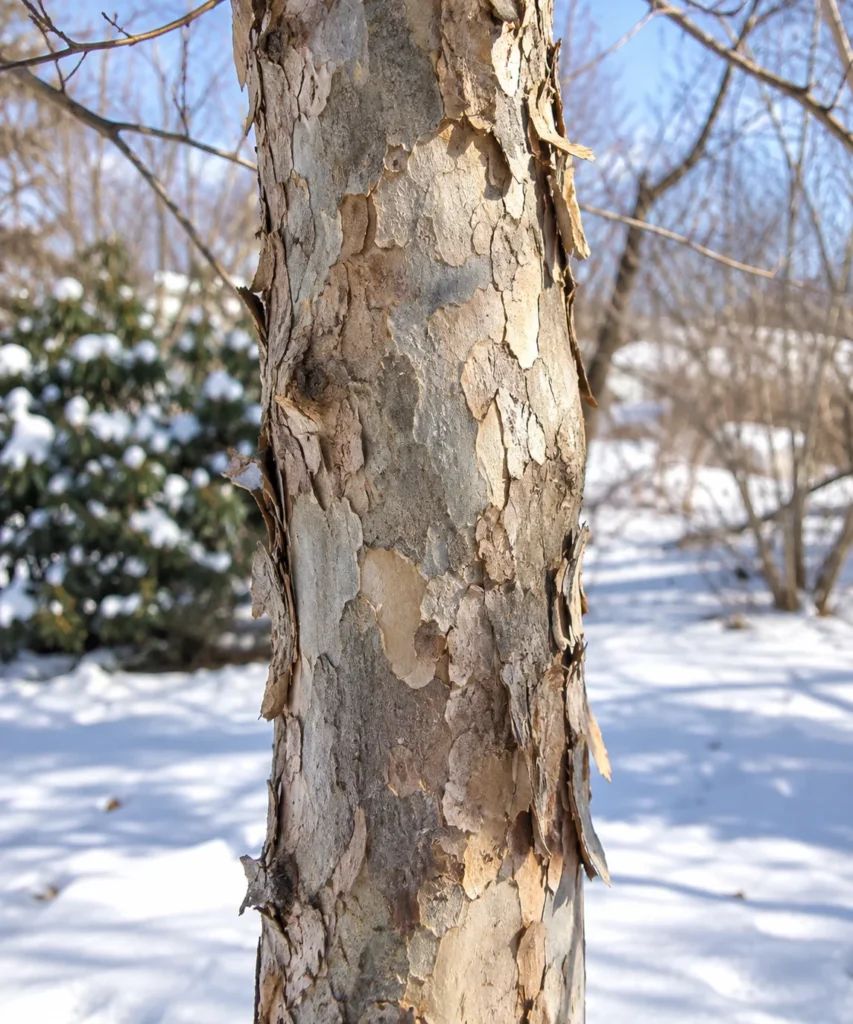
In fall the leaves usually turn orange and red. In winter, the peeling gray-brown bark shows off the shape of the trunk once the leaves are gone. It isn’t the cinnamon color of some other types, but it’s attractive in its own right.
Mildew resistance: what it does and doesn’t mean
Powdery mildew appears as a dusty white coating on crape myrtle leaves and flower buds. It often shows up in humid or shaded places, and it can stunt growth and make the tree look sickly.
Muskogee was bred for resistance to mildew. The University of Florida’s Environmental Horticulture publication notes that powdery mildew can severely affect crape myrtles, but Muskogee is highly resistant. This resistance is one of the reasons that Muskogee became popular in the Southeast and mid-Atlantic. Muskogee comes from a cross between L. indica and L. fauriei. The L. fauriei parent contributes much of the disease resistance.
Two caveats are worth knowing:
- “Resistant” isn’t “immune.” In wet, humid weather, or if the tree is crowded by other plants and doesn’t get enough sun, you might notice a little mildew on some leaves. It rarely gets serious on a Muskogee planted in the right spot.
- Other pests can still show up. Aphids are the usual culprit. They give off honeydew, a liquid that can lead to a black film known as sooty mold on leaves and on anything under the tree. It doesn’t look nice. It usually doesn’t harm a healthy tree. A strong blast of water can often knock the aphids off. Helpful insects like lady beetles can also keep aphid numbers down.
Also keep an eye out for crape myrtle bark scale, a recent pest in the southern United States. The crape myrtle bark scale can leave white or gray patches on bark and a black sooty coating underneath. If you are located in the Southeast or Texas you should check with your state’s Extension office for guidance because recommendations for crape myrtle bark scale are still evolving and differ from one region to another.
Where it grows best
Muskogee grows best in zones 7 through 9. These zones cover much of the Southeast, the Gulf Coast, and the mid-Atlantic region. Parts of the Southwest and California fall in these zones as well. Some references say zone 6, and others go as far as zone 10. Not sure where you fall? If you’re in Tennessee, our Tennessee planting zones guide can help you check.
- Zone 6: A protected site can work. Expect some winter dieback now and then. The Missouri Botanical Garden says that in colder zones the top growth might die back during tough winters, but the roots often survive and come back in spring. Since flowers form on new wood, a tree that dies back and regrows can still bloom. It just won’t develop a sturdy trunk.
- Zones 7–9: The sweet spot. Expect strong growth and blooming.
- Zone 10: Some nurseries list it here. Crape myrtles generally want a bit of winter chill, so results vary.
If you live in the Pacific Northwest or a cooler northern zone, a different plant will probably work for you better. Crape myrtles need summer heat to flower well.
How to plant it
Pick the spot first. Full sun is the important factor. Aim for at least 6 hours of direct sunlight each day. Without sun, plants may not flower well and can develop mildew even if they are a variety that is supposed to resist it. Looking for companions that also thrive in full sun? See our guide to heat-tolerant plants for full sun or our Mexican heather growing guide.
Give it space. Plan on 10 to 15 feet from buildings, fences, and other trees for a mature Muskogee. More space is better if you want the crown to spread naturally. Muskogee looks its best when it has room to grow without crowding, which helps it stay healthy and full. Planted too close to other things, it can get stressed or lopsided. If you can, give it extra space.
Check drainage. Muskogee tolerates many soil types, including clay, sand, acidic, and alkaline soils, according to nurseries and universities. What it does not like is soil that doesn’t drain well.
Plant at the right depth. Dig a hole that’s about as deep as the root ball and two to three times wider. Place the plant so the top of the root ball is level with or slightly above the surrounding soil. Backfill with the native soil, water thoroughly, and then add two to three inches of mulch. Keep the mulch a few inches away from the trunk.
Timing. In most of the South, fall or early spring planting gives roots time to establish before summer heat. Container‑grown trees can be planted through much of the growing season if you water consistently.
Ongoing care
Water. Give a newly planted tree deep, regular watering during its first growing season, and keep watering it during dry periods in the second year. Once established, Muskogee can handle drought. Summer bloom will be better if you give it an occasional deep watering during dry weeks.
Fertilizer. Usually not much is needed. Too much nitrogen can lead to lots of leaves and fewer flowers. A soil test from your county Extension office will show if anything is actually missing.
Pruning. Do it in winter before new growth starts. Remove dead wood, crossing branches, and suckers at the base. If you want a multi‑trunk look, choose three to five stems and keep them.
Avoid the practice of crape murder, which means cutting every branch down to stubs each year. This method doesn’t improve flowering. It weakens the branches and leaves ugly stumps. On a fast-growing tree like Muskogee, heavy topping causes a flush of weak, thin new growth. If a tree is too big for its spot, it is better to replace it with a smaller type than to keep making big cuts every year.
Deadheading. Not needed. Taking off flower heads on a small tree could lead to a little more blooming, but on a 20-foot tree it just isn’t practical.
Common mistakes to avoid
- Planting it too close to the house or driveway. The most common regret with this variety is not realizing how big it will get. Many people assume it will stay small, but it ends up much larger than expected, which causes space and maintenance problems. Check the mature size before planting.
- Planting in too much shade. Fewer flowers and more foliage disease follow.
- Over-mulching. Piling mulch against the trunk holds moisture and can cause bark problems.
- Heavy annual topping. It ruins the natural shape.
- Expecting hot pink or red flowers. Muskogee is a cool-toned lavender.
Is Muskogee the right crape myrtle for you?
A good fit if:
- You have a large yard and want a flowering shade tree that works as a specimen tree
- You live in zones 7 to 9 and want a low-maintenance tree that resists disease
- You enjoy soft lavender-pink colors and want a tree that grows quickly
Consider something else if:
- Your space is small, or you need a hedge or foundation plant
- You want deep red, white, or vivid magenta flowers
- You garden in a cold northern climate
If white blooms appeal to you more than lavender, another large, mildew-resistant hybrid from the same breeding program is worth a look. Our Natchez crape myrtle care, pruning, and growing guide covers how it compares in size, bark, and upkeep.
Frequently asked questions
How fast does a Muskogee crape myrtle grow?
Extension services describe growth of about 1 to 2 feet per year in good conditions. Growth slows as the tree ages, and heat, sunlight, and water all affect how fast it grows.
Is Muskogee crape myrtle a tree or a shrub?
It is usually grown as a medium-sized tree, with either one trunk or several stems. Some sources refer to it as a bush or a small tree.
Does Muskogee crape myrtle get powdery mildew?
It is highly resistant, and serious infections are uncommon. Small amounts of mildew can still appear in humid areas or in shade.
When does Muskogee bloom?
Most sources say early or midsummer through early fall, depending on your region. Flowers form on new growth.
Can I grow Muskogee in a pot?
It’s a poor fit. The tree wants to reach 20 feet or more, and a container will limit its health and size. A dwarf crape myrtle is a better choice for pots.
What’s the best time to prune it?
Late winter, before new growth begins.
How far from my house should I plant it?
Plan for at least 10 to 15 feet from structures, and consider more if you’re on the large-size end of what your region produces.
Is it deer-resistant?
Some nursery sources list it as deer and rabbit tolerant, but no plant is completely deer-proof, especially young trees when food is scarce.
Sources & References
- University of Florida IFAS, Environmental Horticulture: Lagerstroemia ‘Muskogee’ fact sheet (PDF)
- Clemson Home & Garden Information Center: Crape Myrtle Varieties
- Clemson Home & Garden Information Center: Crape Myrtle
- Missouri Botanical Garden Plant Finder: Lagerstroemia indica ‘Muskogee’