

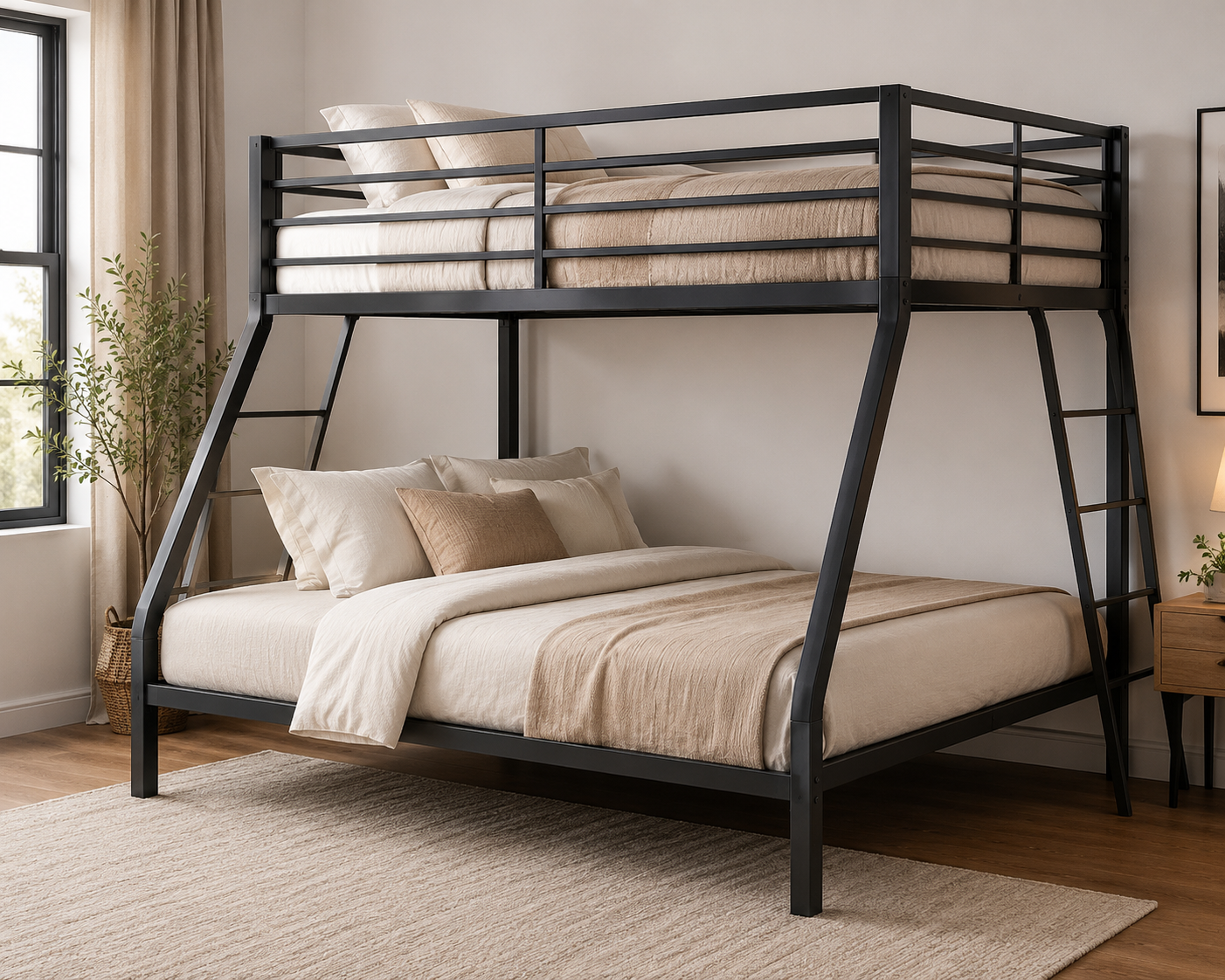
Bunk beds used to belong to kids’ rooms and summer camps. That has changed fast. In 2026, queen over queen bunk beds have become one of the most searched furniture solutions for adults. The reasons make sense once you see the numbers behind rising rent and shrinking square footage.
This guide covers everything you need to know before buying one. You will learn what “heavy duty” actually means for a metal frame. You will also learn which safety standards matter most for adult sleepers, and how to pick the right ladder and guardrail setup. By the end, you will know exactly what to look for and what to avoid.
Quick Safety Checklist
- Frame meets CPSC 16 CFR Part 1213 for adult bunk beds
- Guardrails extend at least 5 inches above the mattress on both sides
- No structural openings between 3.5 and 9 inches (entrapment risk zone)
- Ladder or staircase attaches securely — never just leans against the frame
- At least 24-30 inches of ceiling clearance above the top mattress
Why Adults Are Buying Queen Over Queen Bunk Beds in 2026
Housing costs have pushed more adults toward creative sleeping solutions. Roommates in expensive cities like New York, San Francisco, and Boston increasingly need two full-size sleeping spaces in one room. A queen over queen setup solves that without cutting the room in half with two separate beds.
Short-term rental hosts have also driven demand. Airbnb and VRBO hosts across lake towns, ski regions, and beach markets use queen over queen bunks to sleep more guests per bedroom. That directly boosts nightly revenue without adding square footage. Meanwhile, families with grown children who visit for holidays appreciate a guest room that sleeps four adults instead of two.
Multi-generational households are growing too, and that trend shows no signs of slowing in 2026. Adult children are moving back home. Aging parents are relocating in with family. Blended households all benefit from a bed that maximizes a single room. In short, this is no longer a niche product. It has become a practical answer to a very real space problem.
What Makes a Queen Over Queen Bunk Bed “Heavy Duty”?
Not all metal bunk frames get built the same way. The difference matters more once you add two queen mattresses and two adult sleepers. Here is what separates a genuinely heavy duty frame from a flimsy one.
Steel gauge and construction. Look for thick-gauge steel tubing rather than thin, lightweight metal. Welded joints tend to outperform bolted connections over time. Welds do not loosen the way bolts can after repeated use.
Load rating. A quality adult bunk bed frame should support a substantial static load per bunk. That rating often runs several hundred pounds, well beyond what a single sleeper would ever need. Manufacturers test this through industry standards, which we cover in detail below.
Center support beams. Queen mattresses are wide, so a frame without adequate center support can sag in the middle over time. Look for a center rail or additional legs running the length of each bunk, not just frame supports at the corners.
Powder-coated finish. This is not just about looks. A powder-coated frame resists rust, scratches, and wear far better than a painted or bare metal frame. That durability matters if the bed sits in a guest house, cabin, or humid climate.
Metal Frame vs. Wood Frame: Which Holds Up Better?
Buyers often ask whether metal really beats wood for a queen over queen setup. For adult use, metal usually wins on a few key points. Steel frames resist warping over time, even under the combined weight of two queen mattresses and two adult sleepers night after night. Wood frames, by contrast, can develop squeaks and slight sagging under the same conditions, particularly with lower-quality lumber or cheaper joinery.
Metal frames also tend to disassemble and reassemble more easily if you move. Wood frames, especially solid hardwood builds, can look more polished in a finished guest room. So the choice sometimes comes down to aesthetics rather than pure durability. If you do choose wood, look for mortise-and-tenon joinery over simple screwed connections. That construction style holds up far better under repeated stress.
For rental properties, cabins, and heavy-use guest rooms, metal remains the more practical choice in most cases. It shrugs off humidity swings better than wood, which matters for lake houses and coastal rentals in particular.
Weight Capacity and Safety Standards You Should Know
Adult bunk beds fall under a different federal safety category than children’s bunk beds. This distinction matters when you shop. The Consumer Product Safety Commission regulates children’s bunk beds under 16 CFR Part 1513. Adult bunk beds, meanwhile, fall under 16 CFR Part 1213. Both share core safety principles, even though the rules target different users.
Guardrails need to extend at least five inches above the top of the mattress on both sides of the upper bunk. That margin has to run for at least half the distance between the corner posts. This five-inch buffer keeps sleepers from rolling off during the night. That protection becomes even more important with a queen mattress, since adults naturally move more than children while sleeping.
Openings in the structure also need to avoid a dangerous middle range. Anything between roughly three and a half inches and nine inches creates an entrapment risk. Reputable manufacturers design around that zone entirely. You can review the full federal requirements directly through the CPSC’s official bunk bed safety page. It breaks down guardrail continuity, entrapment prevention, and labeling requirements in detail.
Before you buy, check that the listing specifically states compliance with these CPSC standards. A generic “safety tested” claim is not enough on its own. Reputable adult bunk bed manufacturers will list this clearly in the product description or spec sheet.
Ladder Types: Straight, Angled, and Staircase
The ladder often gets overlooked. But it matters just as much as the frame itself, especially for adult users climbing up and down nightly.
Straight ladders. These attach vertically or near-vertically to the bed frame. They take up the least floor space, which makes them popular in smaller rooms. However, they can feel less stable for adults compared to other options.
Angled ladders. These lean against the bed at a slight angle. That angle generally feels more natural to climb and puts less strain on your arms and shoulders. Angled ladders do require a bit more floor space at the base, so measure your room before committing.
Staircases. Some heavy duty queen over queen models now include a full staircase instead of a ladder. Many include built-in storage drawers underneath each step. This option costs more and takes up the most space. Still, many adults find it dramatically easier and safer to use, particularly at night or for anyone with mobility concerns.
Whichever style you choose, confirm the ladder or staircase attaches securely to the frame. It should never simply lean against it unsecured. A loose ladder is one of the most common complaints in bunk bed reviews, and it is also a real safety risk.
Guardrails: What Adult Sleepers Should Look For
Guardrails matter even more for adults than most people assume. Two queen mattresses side by side naturally invite more shifting and movement during sleep. Beyond meeting the five-inch minimum height above the mattress, look for guardrails that run continuously along both long sides of the upper bunk rather than stopping partway.
Removable or adjustable guardrail sections can help if you ever plan to reconfigure the room. Just make sure any removable section still locks securely in place during normal use. A guardrail that wiggles or detaches easily under pressure defeats its entire purpose.
Finally, check the corner post height. Corner posts should extend well above the guardrail itself. That extra height creates the safety margin that keeps a rolling sleeper from going over the edge entirely.
Choosing the Right Room and Ceiling Height
Queen over queen bunk beds are tall, and this trips up more buyers than any other factor. Most heavy duty frames stand between 70 and 80 inches high. You need enough clearance above the top bunk for a comfortable sitting position, not just enough room for the frame itself.
Measure your ceiling height first. Then subtract the bed height and mattress thickness to see how much headroom remains on the top bunk. Aim for at least 24 to 30 inches of clearance above the top mattress, so an adult can sit up without hitting their head on the ceiling.
Also consider the room’s other features before you commit. Ceiling fans, light fixtures, and low windows can all interfere with a bunk bed’s placement. Walk through the room with a tape measure before you order.
Mattress Considerations for Queen Over Queen Setups
Mattress thickness directly affects your safety margin, since a thicker mattress reduces the effective guardrail height. Most manufacturers specify a maximum mattress thickness for their frame, often somewhere between 8 and 12 inches. Going beyond that limit can push your guardrails below the required safety threshold.
Weight also matters more than people expect. Standard innerspring or hybrid queen mattresses can weigh 100 pounds or more. Moving one onto an upper bunk is usually a two-person job. Memory foam mattresses tend to weigh less, and they often compress for easier maneuvering onto the top bunk during setup.
Finally, think about motion isolation if two adults will share the lower bunk. A mattress with strong motion isolation reduces disturbance from movement. This matters more here than in a typical bedroom setup, since bunk bed frames can transmit vibration between levels more noticeably than a standard bed frame.
Assembly and Maintenance Tips
Most heavy duty queen over queen bunk beds ship in several large boxes. They require two people for safe assembly. Plan for two to four hours of setup time, and clear the room completely before you start, since these frames need space to maneuver during construction.
Tighten every bolt fully during assembly, then recheck them again after the first week of use. Metal frames can settle slightly under weight. A quick re-tightening session prevents the rattling or shifting that often gets blamed on the frame itself.
Check the ladder or staircase attachment points every few months, along with the guardrail brackets. This takes only a few minutes, and it catches loose hardware before it becomes a safety issue rather than after.
If you are furnishing a guest room or rental property with a smaller footprint, our twin XL loft bed guide covers a more compact space-saving alternative worth comparing.
Best Uses for Adult Queen Over Queen Bunk Beds
This style of bed fits more situations than most people initially expect. Short-term rental properties benefit enormously, since sleeping four adults in one bedroom instead of two can meaningfully boost booking value in vacation markets. Lake houses, ski cabins, and beach rentals across the country have increasingly adopted this setup for exactly that reason.
If you’re weighing this against a matching dresser and nightstand set for the same room, our dresser and nightstand guide covers sizing for shared bedrooms. Ranch and farm guest houses represent another strong fit. This works especially well for properties that host seasonal workers or extended family during harvest or holiday visits. Multi-generational homes, blended families, and roommate households in high-cost cities round out the most common use cases. All of them share the same underlying need: more sleeping capacity without more square footage.
Final Thoughts on Buying an Adult Queen Over Queen Bunk Bed
A heavy duty queen over queen bunk bed solves a real problem for a lot of American households in 2026. That problem might be rising rent, a busy guest room, or a rental property trying to sleep more guests per bedroom. Prioritize a genuinely heavy duty steel frame. Confirm the guardrails meet current CPSC standards, and measure your ceiling height before you order. Get those three things right, and this style of bed can serve your household comfortably for many years.
Frequently Asked Questions
Are queen over queen bunk beds safe for adults?
Yes, when the frame meets current CPSC standards under 16 CFR Part 1213. It also needs properly sized guardrails and a securely attached ladder. Always check the weight capacity and confirm the guardrails extend at least five inches above the mattress surface.
How much weight can a heavy duty metal bunk bed frame hold?
This varies by manufacturer, but quality adult bunk frames typically support several hundred pounds per bunk under static load testing. Always check the specific weight rating listed by the manufacturer, rather than assuming based on frame appearance alone.
What is the average height of a queen over queen bunk bed?
Most heavy duty frames stand between 70 and 80 inches tall. Measure your ceiling height before buying, to ensure enough clearance for an adult to sit upright comfortably on the top bunk.
Can two adults sleep comfortably on a queen over queen bunk bed?
Yes, each bunk holds a full queen mattress. That gives each level the same sleeping space as a standard queen bed. Comfort ultimately depends on mattress quality and the frame’s structural support, particularly its center beam.
What type of ladder is best for adults?
Angled ladders and staircases tend to feel more natural and stable for adult users compared to straight vertical ladders. Staircases work especially well if floor space allows, since many models include built-in storage as well.
Do adult bunk beds meet the same safety standards as children’s bunk beds?
They meet related but separate standards. Children’s bunk beds fall under 16 CFR Part 1513. Adult bunk beds are regulated under 16 CFR Part 1213, though both address guardrail height, entrapment prevention, and structural integrity.
How much does a heavy duty queen over queen bunk bed cost?
Prices typically range from around 600 dollars for basic metal frames to over 1,500 dollars for premium heavy duty models with staircases or built-in storage. Mattresses add to the total cost separately in most cases. Two queen mattresses together often cost as much as the frame itself, so budget for both pieces before you commit.
Is a queen over queen bunk bed a good option for a rental property?
Yes, many short-term rental hosts use this configuration to sleep more guests in a single bedroom without renovating or adding square footage. This can meaningfully increase booking value in vacation rental markets.
[…] you’re also weighing bunk-style options for a shared kids’ room, our queen-over-queen bunk bed guide covers a larger-scale alternative worth […]