

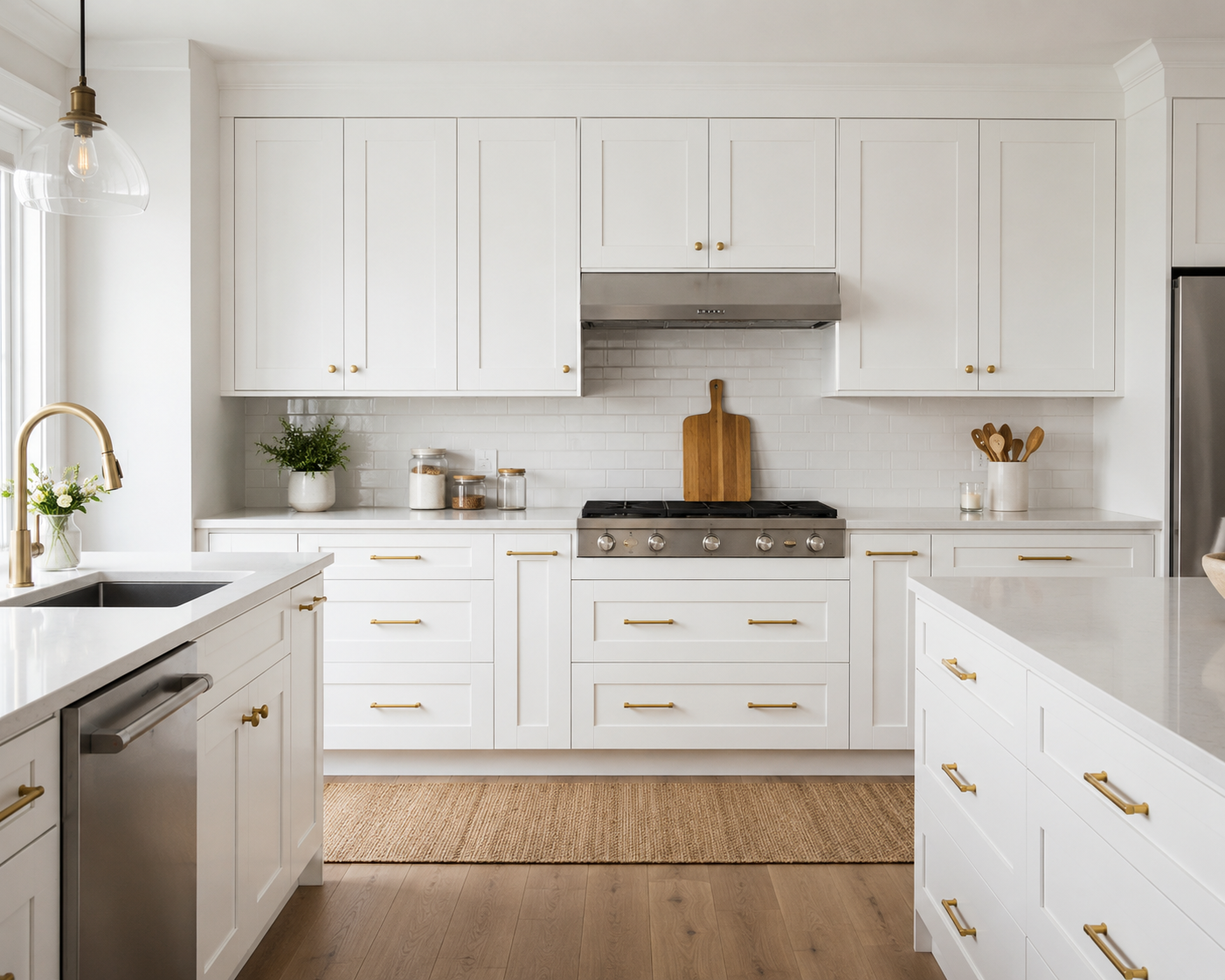
White shaker cabinets have led American kitchens for over a decade. In 2026, they still hold their ground. But the look itself is quietly changing. Maybe you last renovated five or ten years ago. If so, today’s white shaker cabinets won’t look quite like the ones you remember.
This guide breaks down what white shaker cabinets cost this year. It also covers how the style has evolved, which materials hold up best, and how to dodge common budgeting mistakes. Whether you’re planning a full remodel or just swapping cabinet doors, you’ll walk away with a clear, current picture. Then you can call a contractor with confidence.
What Makes a Cabinet “Shaker” Style
The shaker door keeps things simple. It has a flat, recessed center panel framed by four clean rails. There’s no carving, no raised detailing, and no ornamentation. That simplicity traces back to the Shaker religious community of the 18th and 19th centuries. Their furniture makers valued function over decoration. Ironically, that same restraint explains why the style has aged so well. A shaker door won’t lock you into one design era. It works in a farmhouse kitchen just as easily as a modern, minimalist one.
White is simply the most common paint choice for this door style. It’s not a separate cabinet category. Because of that, white shaker cabinets cost the same as any other color. Your price depends on the material, the construction quality, and whether you choose stock, semi-custom, or custom. The paint color itself barely moves the needle.
How Much Do White Shaker Cabinets Cost in 2026?
Homeowners usually ask this question first. The honest answer: it depends heavily on which tier you pick. Here’s a breakdown of current 2026 pricing by cabinet type.
| Cabinet Type | Cost Per Linear Foot | Typical Total (25 Linear Feet) |
|---|---|---|
| Stock | $100 – $300 | $2,500 – $7,500 |
| Semi-Custom | $150 – $650 | $3,750 – $16,250 |
| Custom | $500 – $1,200+ | $12,500 – $30,000+ |
Manufacturers pre-build stock cabinets in standard sizes and ship them ready to install. That keeps costs down, but it limits your layout flexibility. Semi-custom cabinets let you adjust sizing and finishes within a manufacturer’s existing line. Most homeowners land here, since it balances flexibility with a reasonable price. Custom cabinets get built to your kitchen’s exact dimensions using premium materials. They cost the most, but they’re your best option for an unusual layout or features no stock line offers.
A typical 10-by-10-foot kitchen needs 20 to 25 linear feet of cabinetry. Total cabinet costs for that size generally fall between $2,000 and $24,000, depending on your tier. Installation labor adds another $50 to $450 per linear foot on top of that. So ask for a fully itemized quote. Don’t settle for a single lump-sum number.
Regional Cost Differences Across the U.S.
Cabinet pricing isn’t uniform across the country. Keep that in mind before you judge a quote as too high or too low. Coastal metro areas like San Francisco, New York, and Boston tend to charge higher labor rates than the Midwest or parts of the South. Sometimes that gap runs 20 to 30 percent for the same job. Humid climates along the Gulf Coast and Southeast, including Houston, New Orleans, and Miami, need plywood box construction instead of particleboard. Humidity and moisture exposure will eventually warp cheaper materials. If you live in one of these regions, pay slightly more upfront for moisture-resistant construction. That beats replacing swollen cabinet boxes a few years down the road.
Homeowners in drier climates, like the Southwest, get more flexibility with materials, since humidity matters less there. Either way, ask your contractor for climate-specific recommendations. A generic online estimate won’t account for local humidity, freeze-thaw cycles, or regional labor rates.
What’s Changed: 2026 Style Trends for White Shaker Cabinets
The white shaker cabinet of 2026 looks familiar at first glance. But a few details separate it from the version that dominated kitchens a decade ago.
Slimmer frames. Traditional shaker rails measured 2.5 to 3.5 inches wide. Many manufacturers now shrink that down to roughly 0.5 to 1 inch. Designers call this look “skinny shaker” or “micro-shaker.” It keeps the recessed panel and shadow line that defines the style. But it trades the bulkier, traditional look for something closer to Scandinavian minimalism.
Warmer whites over stark whites. Bright, cool-toned white is giving way to warmer, creamier shades with ivory or soft gray undertones. Designers also lean into two-tone kitchens now. They pair white uppers with a darker lower cabinet color, like navy, forest green, or walnut. That combination keeps the room feeling bright without looking flat or clinical.
Hardware does more of the visual work. Chunky pulls from the late 2010s have given way to slim, elongated hardware. Much of it runs two-thirds the height of the door. Mixed metals show up often in 2026 kitchens, especially brushed brass paired with matte black or polished nickel. Push-to-open mechanisms are also gaining ground for a cleaner, handle-free look.
Texture beats pure gloss. Homeowners use high-gloss white finishes sparingly now, more as an accent than a default. Matte and satin finishes dominate instead. They hide fingerprints and daily wear better, and they still photograph beautifully.
None of this means white shaker cabinets are falling out of favor. In fact, homes with white cabinetry consistently sell faster and for a premium compared to homes with darker cabinets. That’s part of why the style keeps returning, even as the finer details shift year to year. If resale value matters to you, that’s a solid, data-backed reason to stick with white instead of chasing a trendier color.
Choosing the Right White Shade
Not all white paint reads the same once it’s on a cabinet door. Lighting in your specific kitchen matters more than most people expect.
- Bright or cool white works well in kitchens with plenty of natural light. It pairs nicely with cool-toned countertops like gray quartz or marble.
- Dove white carries a faint bluish undertone. It looks sharp next to navy islands or gray flooring.
- Warm or ivory white suits kitchens with wood flooring, brass fixtures, or south-facing windows. It avoids looking sterile in rooms that already run warm.
- Linen white is a softer, slightly muted off-white. It adapts well to almost any countertop or backsplash, which makes it a safe pick if you’re unsure which direction to take the room.
Test a sample door or paint swatch in your actual kitchen lighting before committing. A shade can look perfect under showroom lighting. Then it shifts noticeably once it’s under your own fixtures.
Material Options and What They Mean for Durability
The material behind the paint has a much bigger impact on longevity than most homeowners realize.
- MDF (medium-density fiberboard) is smooth, affordable, and takes paint evenly. That’s why manufacturers use it as the standard for most stock and semi-custom shaker doors. It holds up well as long as it avoids consistent moisture.
- Plywood costs a bit more, but it resists warping and moisture damage better than MDF. That makes it the smarter choice in humid climates or busy households.
- HDF (high-density fiberboard) offers a denser, more moisture-resistant upgrade from standard MDF. Premium semi-custom and custom lines often use it.
- Solid wood, typically maple, oak, or poplar, is the most durable and the most expensive option. Manufacturers usually reserve it for custom cabinetry.
Don’t chase the cheapest material if you plan to stay in your home for more than five or six years. The cost gap between MDF and plywood construction is often smaller than people expect. The added durability tends to pay for itself.
Design Pairings That Work in 2026
White shaker cabinets work as a neutral base by design. But a few pairings show up consistently in current kitchens.
- Warm white cabinets with white oak open shelving create a softer, more layered look than an all-white kitchen.
- White uppers with a navy or sage green island add contrast without overwhelming a smaller kitchen.
- Brushed brass or unlacquered brass hardware has largely replaced matte black as this year’s default premium finish.
- Honed or leathered quartz countertops work better than high-gloss stone here. Matte countertop finishes pair well with the softer, warmer white cabinet tones now in style.
Maintenance Tips to Keep White Cabinets Looking New
White cabinets show grease, fingerprints, and grime faster than darker colors. A little routine care goes a long way.
- Wipe down cabinet fronts weekly with mild soap and water, especially around handles and areas near the stove.
- Avoid abrasive sponges or harsh chemical cleaners. They can dull the paint finish over time.
- Address grease splatter near the cooktop promptly. Buildup left too long can yellow the finish.
- Choose satin or matte finishes over high-gloss if your household includes kids or frequent cooking. Matte surfaces hide smudges more effectively.
- Touch up paint on high-contact areas, like handles and drawer edges, every few years to prevent visible wear.
New Finish Technology Worth Knowing About
A few practical upgrades have quietly become standard on premium white shaker lines this year. Ask about them even if you’re shopping mid-range. Manufacturers once reserved anti-fingerprint coatings for high-end custom cabinetry. Now many semi-custom product lines include them too. These finishes cut down visible smudging around handles and other high-touch areas. That matters more on white cabinets than on any other color.
Antibacterial coatings are becoming more common too, especially in kitchens where food prep surfaces sit close to cabinet fronts. Neither upgrade will dramatically change your total budget. But both can meaningfully cut down the extra cleaning that white cabinets tend to demand. If durability and low maintenance matter as much as the look, ask your supplier directly. Find out whether these coatings come included or as an add-on before you finalize your order.
Soft-close hinges and drawer glides have also become close to standard now, even on many stock cabinet lines. If a quote skips them, ask why. The added cost is usually minor compared to the daily convenience.
Is a White Shaker Cabinet Still the Right Choice for You?
Plenty of bold colors are trending in 2026, from sage green to deep navy. So it’s worth asking whether white shaker cabinets still make sense for your project.
They’re a strong choice if you want a kitchen that photographs well, appeals to future buyers, and won’t feel dated in five years. They’re less ideal if you’re drawn to a bolder personal style. They also demand more upkeep than darker surfaces, so weigh that tradeoff honestly. There’s no wrong answer here. Just understand the tradeoff upfront, so you don’t regret the choice later.
Still weighing cabinet colors against your overall renovation budget? Check out this broader kitchen remodel cost guide. It breaks down where countertops, flooring, and labor fit alongside cabinetry.
Actionable Tips Before You Buy
- Get at least three quotes. Cabinet pricing varies widely between contractors, even for the same materials and finish.
- Ask for the box material in writing. Your quote should spell out “plywood box construction,” not just imply it verbally.
- Request a physical door sample. Photos and screens don’t show true color or sheen accurately.
- Budget an extra 10 to 15 percent for unexpected costs like trim, fillers, or minor structural adjustments.
- Confirm lead times early. Custom and semi-custom cabinets can take four to twelve weeks to arrive, which affects your overall renovation timeline.
The National Kitchen & Bath Association reports that cabinetry typically accounts for the largest single line item in a kitchen renovation budget. That’s exactly why you should spend extra time comparing quotes before you commit to one supplier.
Frequently Asked Questions
Are white shaker cabinets still in style in 2026? Yes, though the look has shifted. Stark, bright white is giving way to warmer, creamier tones. Two-tone kitchens that pair white uppers with a darker lower cabinet color are increasingly common this year.
How much do white shaker cabinets cost per linear foot? Stock cabinets typically run $100 to $300 per linear foot. Semi-custom ranges from $150 to $650. Custom cabinets can exceed $1,200 per linear foot, depending on materials and finishes.
What’s the difference between shaker and flat panel cabinets? Shaker doors use a five-piece frame with a recessed center panel. Flat panel doors use a single flat piece instead. That added construction typically makes shaker doors slightly more expensive than basic flat panel options.
Do white cabinets show dirt more than darker colors? Generally, yes. Fingerprints, grease, and grime show up more visibly on white surfaces. Regular cleaning matters more here than it would with a darker cabinet color.
What material is best for white shaker cabinets in humid climates? Plywood box construction holds up better than particleboard or basic MDF in humid regions like the Gulf Coast, Southeast, and parts of the Northeast. It resists warping and moisture damage more effectively.
Do white kitchens increase home resale value? Homes with white cabinetry have historically sold faster and at a modest price premium compared to homes with darker cabinet colors. That makes white a lower-risk choice if resale value is a priority.
What hardware pairs best with white shaker cabinets in 2026? Brushed brass, unlacquered brass, and mixed metal combinations are the most common choices this year. They’ve largely replaced the matte black hardware that dominated the previous few years.
How long does it take to install new white shaker cabinets? Installers can often finish stock cabinets within a few days once they arrive. Semi-custom and custom orders typically take four to twelve weeks to arrive before installation even begins.
Final Thoughts
White shaker cabinets earned their staying power the honest way. They’ve proven, decade after decade, that they work in nearly any kitchen style. What changed in 2026 isn’t the core idea, but the details around it: slimmer frames, warmer color tones, and hardware that does more of the visual heavy lifting. If you’re planning a remodel this year, treat those small updates as an opportunity, not a requirement. Choose your white shaker cabinet thoughtfully, pair it well with your countertop, flooring, and hardware, and it will likely still look right at home a decade from now.
[…] you’re planning a larger renovation alongside your plinth upgrade, our white shaker cabinets guide covers cost and style considerations for the cabinetry your plinth will need to […]
[…] a popular bathroom floor pairing. And if you’re leaning toward a Shaker-style vanity, our white shaker cabinets guide covers the same door style for your kitchen if you want a cohesive look throughout the […]