

Quick answer: Plant dahlia tubers 4 to 6 inches deep, lying on their sides with any visible sprout facing up, once the soil reaches about 60°F. Hold off on watering until green shoots appear. Give the plants full sun and a stake, go easy on nitrogen, and pinch the young stems. In most of the country, dig the tubers after the first hard frost and store them at 40°F to 50°F. In zones 8 and warmer, you can often leave them in the ground under mulch if the soil drains well.
Most dahlia failures trace back to a handful of causes: planting into cold wet soil, watering too early, feeding with the wrong fertilizer, or storing tubers somewhere too damp or too cold. This guide covers each of those, plus how to adjust for your part of the country.
What a dahlia tuber actually is
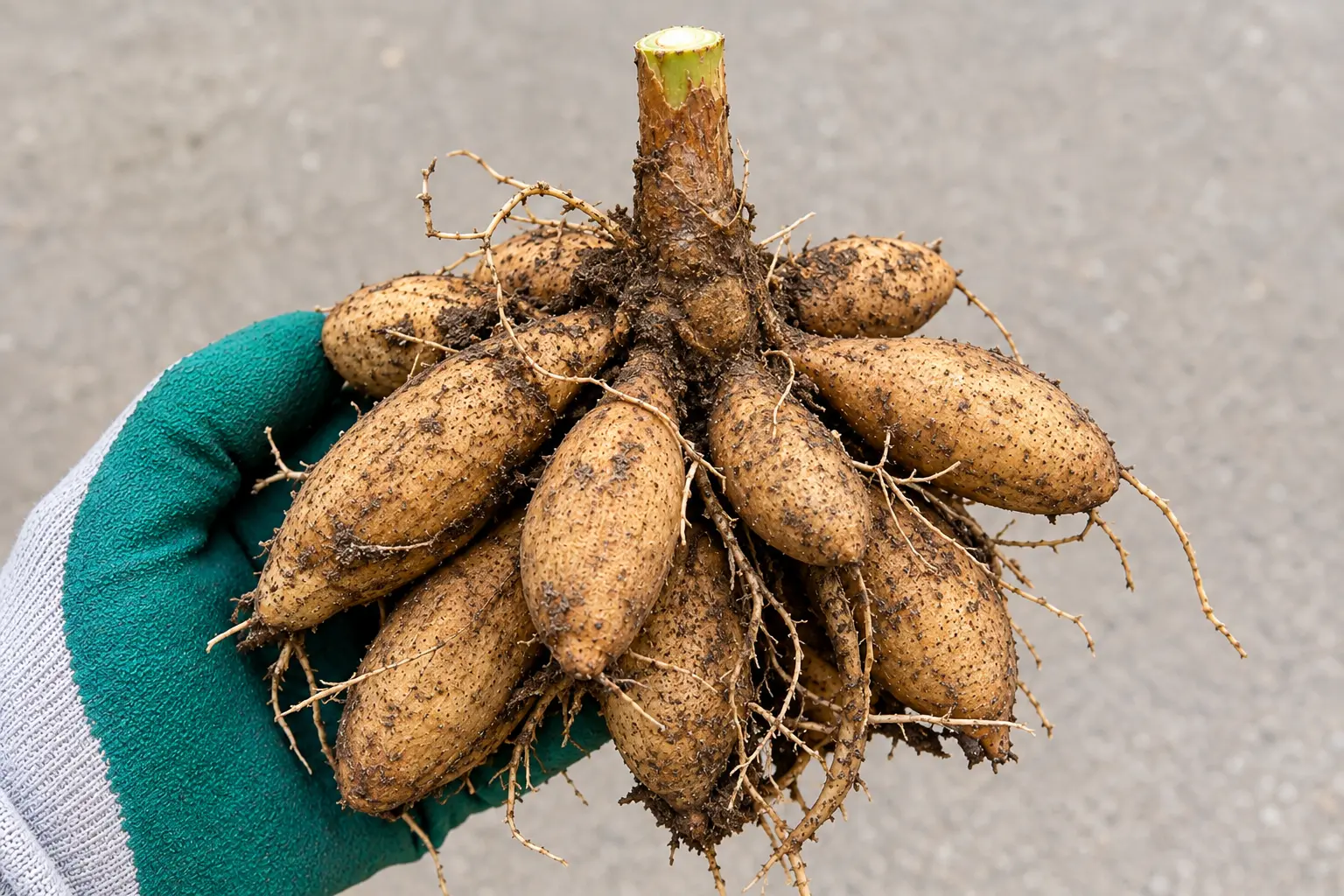
A dahlia tuber looks a bit like a small sweet potato, but it works differently from a spring bulb. It’s a storage root. The new plant grows from an “eye,” a small bump on the crown where the tuber meets last year’s stem. A tuber with no eye, or one that has snapped off at the neck, won’t grow. Growers call these “blind” tubers.
That detail explains a lot. Unlike a potato, a dahlia tuber can’t sprout from its sides or tail. It also explains why a tuber that looks plump and healthy sometimes does nothing: the crown piece was missing when the clump was divided.
Dahlias are native to the highlands of Mexico and Central America. They like warm days, cool nights and well-drained soil. They are tender perennials, so the tubers can’t survive freezing ground.
How to choose and inspect your tubers
A healthy tuber feels firm, much like a fresh carrot or potato. Surface wrinkles after winter storage are normal. A tuber that is wrinkled but still firm and heavy for its size will usually plump up once it meets moist soil. Some growers soak slightly wrinkled tubers in lukewarm water for about an hour before planting. Tubers that are mushy, moldy, or dark inside should be discarded.
Before you buy or plant, check three things:
- The neck. It should be intact. A tuber snapped off below the neck is blind.
- The eye. It may be hidden until warmth wakes it up. Don’t toss a firm tuber just because you can’t see one yet.
- The size of the neck. Penn State Extension notes that necks thinner than a pencil will probably dry out by spring, so thick, sturdy necks store better.
If you’re buying online, tubers often arrive as a single piece or a small clump. Either will grow. Single tubers are easier to plant, while clumps can be divided later.
When to plant dahlia tubers
The main rule is soil temperature, not the calendar. Wait until the soil is around 60°F at planting depth. A basic soil thermometer takes the guesswork out. Planting into cold, wet ground is a common way to lose tubers to rot.
If you want earlier flowers or have a short growing season, you can pot up tubers indoors four to six weeks before your last expected frost. Use damp (not soggy) potting mix, lay the tuber on its side with the eye up, cover it with about an inch of soil, and water sparingly until a sprout shows. Move the potted plant outdoors only after frost danger has passed.
Timing and strategy shift by region:
| Region / zone | What usually works |
|---|---|
| Zones 3–7 (Northeast, Midwest, Mountain West) | Pot up indoors, plant after the last frost, and plan to dig tubers in fall. Short seasons make the head start worthwhile. |
| Zones 8–9 (Pacific Northwest, parts of the Mid-South) | Plant in spring once soil warms. Overwintering in the ground is possible with mulch and good drainage. |
| Hot summers (inland South, Southwest) | Expect a mid-summer slowdown when days stay above about 90°F. Mulch heavily and expect strongest blooms in fall. |
| Zones 10–11 (southern Florida, coastal Southern California) | UF/IFAS Extension lists fall planting (September through December) for the warmest zones. |
Hardiness advice varies by source. Some growers call dahlias reliably perennial in zones 8 to 11, while others say zone 7 is workable with deep mulch. Treat zone 7 as a gamble that depends on your drainage.
How to plant dahlia tubers, step by step
- Pick a spot with full sun, at least six hours a day, and soil that drains. Mix in compost if your soil is heavy, or see our guide to loam topsoil for improving poor soil. Dahlias hate sitting in wet ground.
- Loosen the soil to about 10 to 12 inches.
- Set the stake first. Put a sturdy stake in the hole before the tuber so you don’t spear it later. Tall varieties need support.
- Dig a hole 4 to 6 inches deep. Go a little shallower in heavy clay and a bit deeper in sandy soil.
- Lay the tuber horizontally with the eye or sprout pointing up. Never place it with the eye facing straight down.
- Space plants 12 to 24 inches apart. Oregon State and Washington State Extension materials suggest 18 to 24 inches for many garden types, and big dinnerplate varieties need the most room.
- Cover with soil and don’t water. This surprises people. The tuber holds enough moisture to start, and watering a dormant tuber in cool soil invites rot. Water once green shoots appear.
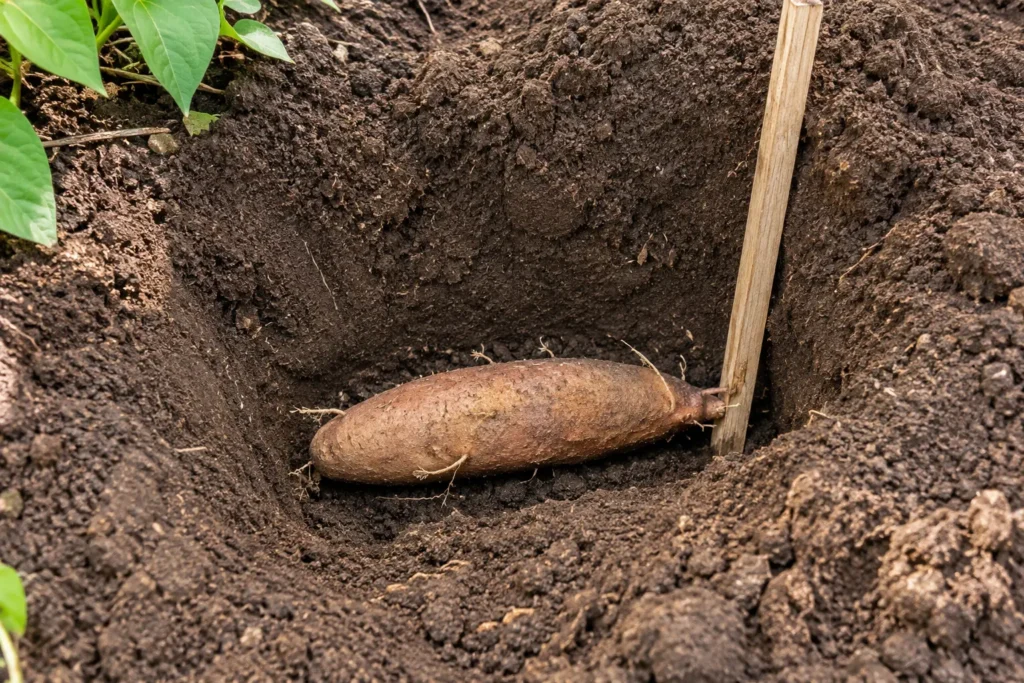
If you plant a lot of tubers, a shallow trench at the same depth works well. Mark each spot, because it’s easy to lose track of what’s underground.
Growing: water, support, pinching, feeding, and pests
Water deeply but not often. Once the plants are up, water evenly. Oregon State Extension advises never letting soil get soggy, since tubers can rot. A 2- to 3-inch layer of mulch, such as shredded bark or straw, keeps soil moisture and temperature steadier. Our black mulch guide covers another option.
Pinch the young stems. Left alone, a dahlia tends to grow one tall stalk with a few flowers on top. When a young plant has several sets of true leaves, pinching out the center tip encourages branching and more blooms. It feels wrong to cut a healthy plant, but it usually pays off.
Skip high-nitrogen fertilizer. Nitrogen builds leaves, not flowers. If a dahlia is huge, deep green and bloomless, too much nitrogen is a common cause. Avoid lawn fertilizer near beds. Look for a formula with a lower first number, such as 5-10-10, or a bloom or tomato fertilizer.
Deadhead and cut flowers often. Removing spent blooms keeps the plant producing. Picking flowers for vases does the same job.
Watch for slugs. Oregon State Extension says slugs love young dahlias and recommends baiting or trapping about two weeks after planting and continuing through the season. Earwigs and spider mites can also bother dahlias, especially in hot, dry weather.
Handle the heat. When daytime highs stay above roughly 85°F to 90°F, dahlias can stall. They typically resume when nights cool. Smaller-flowered types such as pompons are often described as more heat-tolerant than giant dinnerplates. If you garden in the South or Southwest, that’s worth weighing when you choose varieties.
Digging and storing dahlia tubers for winter
If you’re in a cold climate, you’ll want to lift the tubers. Late October is exactly when many US gardeners are doing this. A garden fork does the heavy lifting, and a good garden trowel helps with small clumps and spring planting.
When to dig. Penn State Extension notes dahlias need at least 120 days in the ground to form mature tubers worth storing. Digging doesn’t have to wait for frost, but many gardeners wait until frost blackens the foliage to enjoy every bloom. Penn State’s author, in Zone 5b, typically digs mid-to-late October.
How to dig. Cut the stalk down to a manageable length. Loosen the soil around the clump with a pitchfork or garden fork, working wide of the plant, and lift gently without snapping the necks.
Clean and dry. Remove excess soil, trim thin roots, and let the tubers air-dry out of direct sun. Recommendations differ on drying time. One extension answer suggests 1 to 2 days, while Penn State’s gardener found that four or five days reduced rot. If your climate is humid, lean toward longer.
Divide now or later. Penn State notes fall division is easier on the hands, but eyes are easier to see in spring. Storing the clump whole preserves the eyes and saves you from guessing, though it needs more space. Wherever you cut, make sure each piece has a neck, a crown piece and an eye.
Pack and store. Layer tubers in a slightly breathable medium such as vermiculite, sawdust or cedar shavings, in a ventilated bin. Penn State advises against cardboard, newspaper and paper bags because they wick moisture. Keep the bin off concrete floors and out of freezing temperatures.
Aim for 40°F to 50°F. Penn State Extension and other extension sources give this range. Below freezing kills tubers. Check monthly, discard anything moldy or mushy, and change out damp medium. Most moisture problems show up in the first few weeks.
Should you leave dahlias in the ground?
In zones 8 and warmer, many growers do. Cut the stalks back after frost, add a thick layer of mulch, and make sure the bed drains well. In mild winters the bigger threat is excess moisture, not cold, so raised beds help in wet areas.
Penn State Extension notes that heavy freezing and winter rain promote rot in zones 6 and lower, though a few tubers planted in protected spots near a house have survived. That fits the general pattern: sheltered microclimates can beat the odds, but you shouldn’t count on it with a variety you can’t replace.
Common mistakes
- Planting before the soil reaches 60°F.
- Watering right after planting.
- Using lawn-type or high-nitrogen fertilizer.
- Skipping the stake until the plant is already tall.
- Storing tubers in damp, unventilated containers.
- Letting stored tubers freeze or dry out completely.
Which approach fits you
First-year growers in cold climates: Buy a handful of tubers, pot a few up indoors, and plant the rest directly after frost. Start small so you learn your site before committing to dozens.
Gardeners in hot-summer regions: Choose heat-tolerant, smaller-flowered types, mulch thickly, and plan for a fall peak.
Anyone with limited storage space: Dig and store whole clumps in a cool basement or garage. For the rest of your fall cleanup, see our garden winterizing checklist.
When dahlia tubers may not suit you: If your yard gets less than six hours of sun, or the soil stays soggy and you can’t raise the bed, dahlias will struggle. In those cases, container growing or a different flower may be a better fit.
FAQ
How deep do you plant dahlia tubers?
Plant them 4 to 6 inches deep, lying horizontally with the eye facing up. In heavy clay, go slightly shallower, around 3 to 4 inches.
Should I soak dahlia tubers before planting?
Only if they’re slightly wrinkled. An hour in lukewarm water can help rehydrate them. Firm tubers don’t need soaking, and soaked tubers shouldn’t sit in cold, wet soil.
When should I water after planting?
Wait until you see green shoots above the soil. Watering a dormant tuber in cool ground can cause rot.
Can I plant dahlia tubers upside down?
They’ll often still grow, but it’s better to avoid it. The eye should face up or sit horizontal. Placing it straight down wastes the plant’s energy.
Why didn’t my dahlia tuber sprout?
Common reasons include a blind tuber with no eye, planting in cold or wet soil, or a tuber that dried out or rotted in storage. Potting tubers up indoors lets you check viability before using garden space. If nothing happens after three or four weeks of warmth, it’s probably blind.
Do dahlias need to be dug up every year?
Not everywhere. In zones 8 and warmer, many growers leave them in the ground with mulch. In colder zones, lifting is the safer path.
How long do stored dahlia tubers last?
They’re meant to last one winter in storage, then be replanted in spring. With careful storage, healthy clumps can be divided and replanted year after year.
Why are my dahlias all leaves and no flowers?
Too much nitrogen is a frequent cause, along with too little sun, extreme heat, or planting that started late. Check your fertilizer and be patient, since some varieties bloom late in the season.
Sources & References
- Penn State Extension: Don’t Ditch Those Dahlias, Easy Tips for Winter Storage
- Oregon State University Extension: Fall in love with colorful, dazzling dahlias
- Washington State University Extension: Dahlia Delights, Bold Summer Blooms (PDF)
- UF/IFAS Extension: Figaro Improved Dahlia (FPS170)
- Ask Extension: Dahlias, when to dig and how to store (Minnesota)
- Longfield Gardens: How and When to Plant Dahlias (commercial bulb supplier; used for planting-depth and soil-temperature guidance)
- Old House Gardens: Dahlias for the South (heat and mulching advice from a specialty grower)