

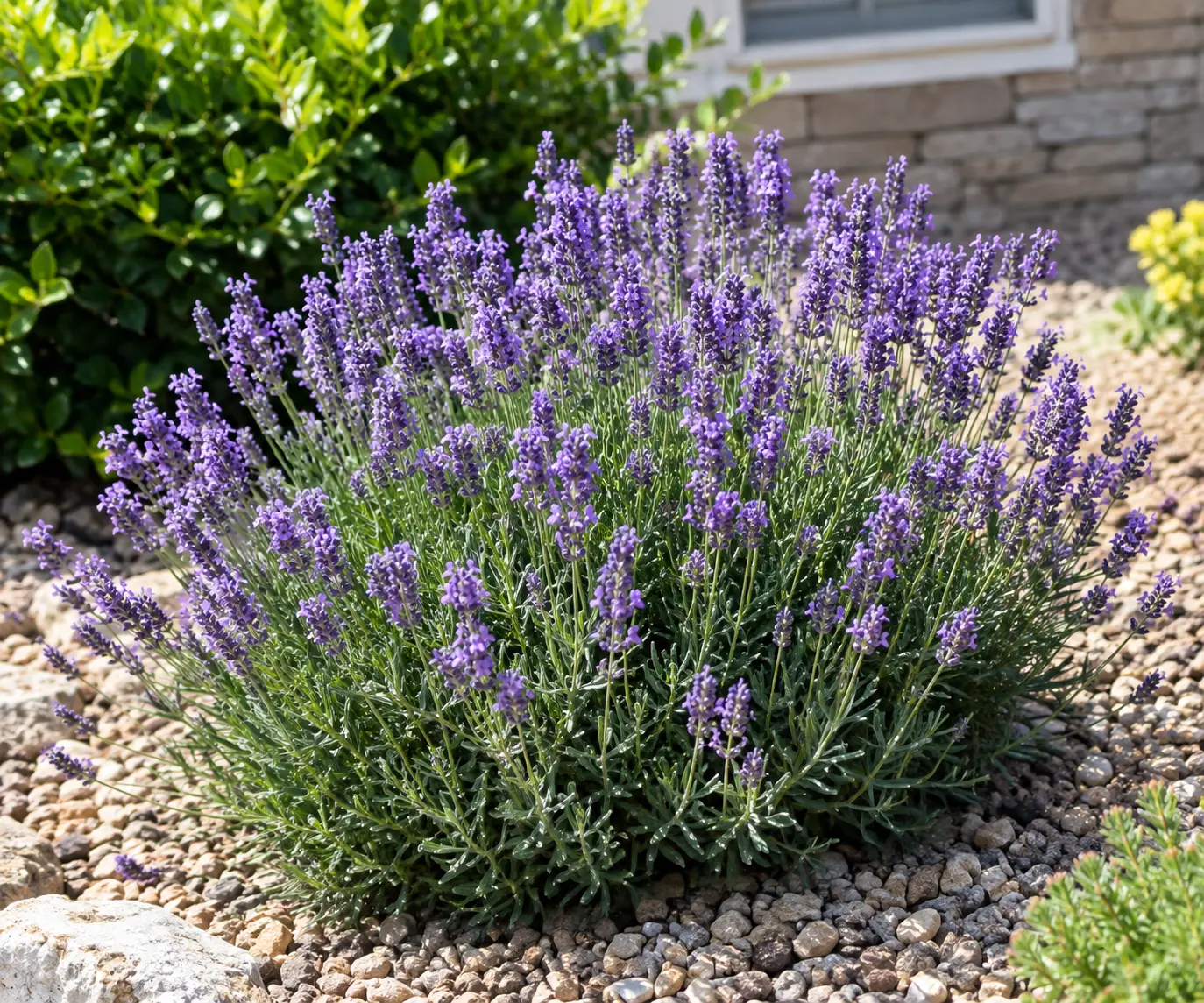
Lavender needs three things: at least 8 hours of direct sun, fast-draining soil and very little water once it’s established. Most lavender that dies was loved to death. It got soil, regular fertilizer, frequent watering and a thick layer of organic mulch. Those habits suit garden plants but they work against a Mediterranean shrub adapted to lean dry rocky ground.
The rest of this guide covers what that means for watering, sun, soil, pruning and winter and how to adjust for your climate.
Quick answers
- Sun: Full sun, at least 8 hours daily, according to University of Illinois Extension.
- Water: Regular watering the first year, then only when the soil has dried out.
- Soil: Well-drained, lean and neutral to alkaline. Drainage matters more than exact pH.
- Fertilizer: Skip it. Extra nutrients push growth and cut down on flowers.
- Pruning: Once a year at minimum. Never cut back into leafless wood.
- Lifespan: plants last about 7 to 10 years per the UC Master Gardeners of San Luis Obispo. Plan to replace them.
Start with the right kind of lavender
“Lavender” covers several species that behave differently and picking the wrong one for your region is the most common reason people fail before they’ve watered anything.
| Type | Botanical name | Typical strengths | Watch out for |
|---|---|---|---|
| English lavender | Lavandula angustifolia | Most cold-hardy (Illinois Extension cites USDA Zones 5–8), compact, classic fragrance. ‘Munstead’ and ‘Hidcote’ are common cultivars. | Can struggle in hot, humid summers |
| Lavandin | Lavandula × intermedia | Larger plants with long flower stems, popular for cutting and drying | Bigger footprint; check the specific cultivar’s hardiness |
| Spanish lavender | Lavandula stoechas | Distinctive “rabbit ear” blooms, suited to mild climates | Generally not reliable in hard winters |
Hardiness varies by cultivar so read the tag rather than trusting the word “lavender.” Extension horticulturists in Illinois note that even cultivars labeled for Zone 5b can be sensitive to a harsh winter, and it can take some trial and error to find what overwinters in your yard.
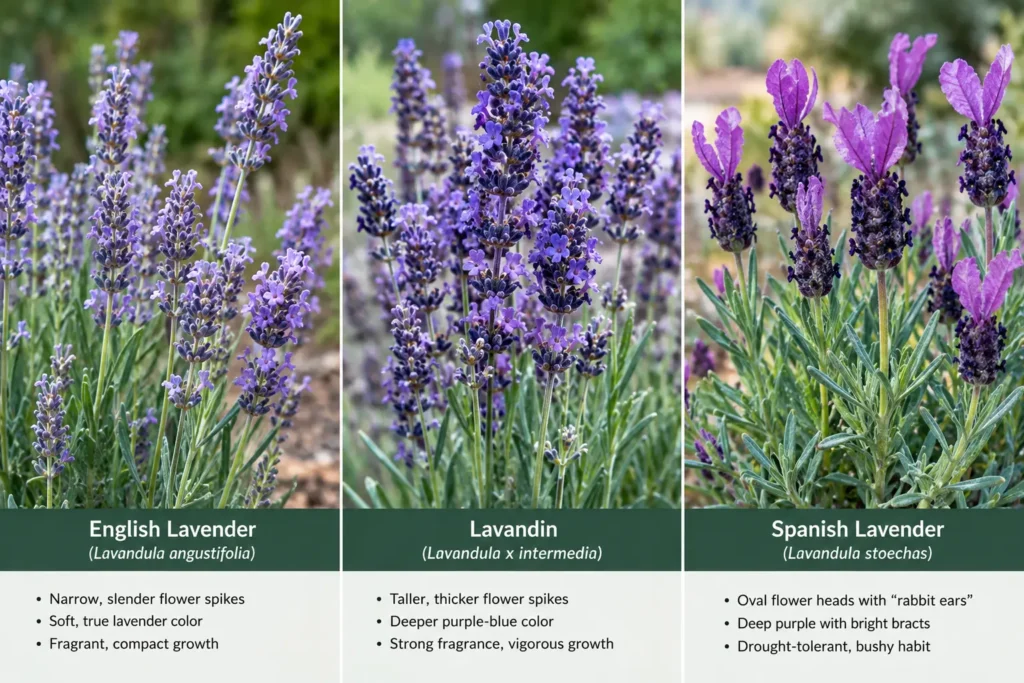
If you’re in a cold-winter region, start with English lavender. In the Southwest or California you have more freedom, and New Mexico State University’s extension materials encourage choosing varieties for your site’s heat, cold and soil rather than buying whatever looks best at the nursery.
Sun: eight hours is a floor, not a target
Give lavender the sunniest spot you have. Six hours of sun will keep it alive, but you’ll usually see floppy, sparse growth and fewer blooms. A south- or west-facing bed works well next to a driveway, wall or walkway where reflected heat helps dry the soil.
Airflow matters as much as light. Lavender planted tightly among perennials stays damp after rain and dew which encourages fungal problems. Space plants 2 to 3 feet apart depending on variety and don’t crowd them with thirsty neighbors. For a sunny bed, our Mexican heather growing guide covers another heat-loving plant, though check its water needs before planting the two side by side.
In the hottest parts of the country, such as inland California or the desert Southwest, lavender tolerates full sun but may appreciate a little afternoon relief in the harshest summer heat, especially in containers. UC Master Gardeners note it appreciates water during heat even though it’s drought tolerant.
Soil: where most lavender plants are won or lost
Drainage is the single most important variable. Lavender roots rot in soil that stays wet and no amount of watering fixes a heavy clay bed that holds water for days.
If your soil drains poorly
Signs your soil is too heavy: water pools after rain, the ground feels sticky when squeezed, or nothing in that spot ever seems to dry out. If that sounds like your yard, you have three options:
- Build a raised bed or mound. Eight to 12 inches of elevated, gritty soil helps considerably.
- Amend with coarse material, such as pea gravel or coarse sand mixed into the planting area rather than compost or peat which holds moisture.
- Use containers. Illinois Extension recommends containers or raised beds with an unfertilized potting mix when native soil drains poorly.
What pH does lavender like?
On pH, sources differ. UC Master Gardeners describe a preference for neutral to slightly alkaline soil (pH 7–8), while Penn State’s PlantVillage lists a broader workable range of 5.8 to 8.3. The practical takeaway: lavender adapts to a range so don’t obsess over pH before you’ve fixed drainage. If you live where soil is strongly acidic such as parts of the Pacific Northwest and Southeast, a soil test and a small amount of lime may be worth considering.
Mulch with gravel, not bark
A finishing touch that surprises people: mulch with sand or pea gravel rather than bark or wood chips and keep it about six inches away from the stems. Extension advice attributed to Colorado State recommends this because organic mulch holds moisture against the crown.
Watering lavender: the honest routine
How often should you water lavender? During the first year, water regularly so roots can establish. After that, water only when the soil has dried out. In a summer with no rain, a slow, deep soak about once a week, letting the soil dry between waterings, is a reasonable starting point, per Colorado State University guidance.
That “once a week” figure is a starting point, not a rule. Sandy soil in Phoenix in July dries faster than loam in Ohio in May. A better test is to push a finger 2 inches into the soil near the plant. If it’s damp, wait.
A few details that make a difference:
- Water deeply and infrequently. Frequent light sprinkling keeps the surface wet and encourages shallow roots.
- Water the soil, not the foliage. Wet leaves in humid weather invite disease.
- Watch drip irrigation. UC Master Gardeners suggest placing emitters to the side of the plant not at its base to reduce the risk of overwatering and root rot.
- Container lavender is different. Pots dry out faster than ground soil so they may need water often in summer. Use a pot with drainage holes and a gritty draining mix and never let it sit in a saucer of water.
Yellowing leaves, a soft or dark base and a plant that wilts even though the soil is wet all point to too much water, not too little.
Pruning lavender without killing it
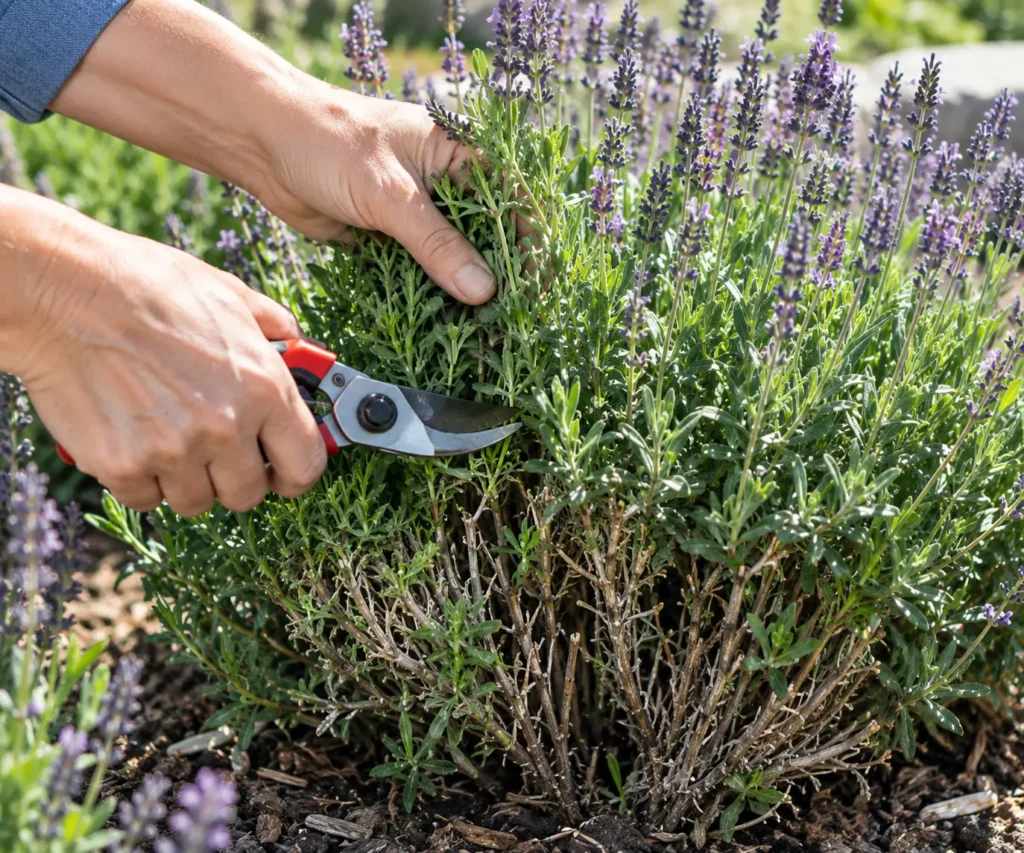
Lavender flowers on new growth, and it turns woody and splits open if you never prune it. The rule that matters most: don’t cut into leafless wood. Lavender generally won’t regrow from it.
Extension sources give different timing and the differences reflect climate:
- Illinois Extension suggests trimming dead stems back to the first set of green leaves when new growth appears in spring and optionally cutting off one-third to one-half of the plant after flowering to keep it compact and possibly get a second bloom.
- Colorado State guidance stresses waiting until green growth emerges in spring so you don’t mistake live stems for winter dieback then removing about a third (up to half) of the top.
- UC Master Gardeners on the California Central Coast recommend pruning after flowers are spent cutting a few inches above the woody part and leaving a couple of inches of green.
Here’s how to reconcile that:
Pruning in cold-winter regions
In cold-winter regions (much of the Northeast, Midwest and Mountain West) do the pruning in spring once you can see where new growth is starting. If you shear lightly after bloom, do it early enough in summer that new growth can harden before frost. I’d avoid pruning in fall in these areas since tender new growth is more vulnerable to winter damage. That’s a horticultural caution rather than something the cited sources spell out.
Pruning in mild-winter regions
In mild-winter regions (Southern California, the Gulf South, parts of the desert Southwest), post-bloom pruning is the standard approach.
The technique is simple. Gather stems in a handful, cut with shears, and aim for a rounded mound shape. Leave some green growth below your cut. If you’re cutting flowers for drying, harvest when a few florets have opened, per UC IPM guidance, and hang the bundles in a cool dry place. If you enjoy dried flowers, our strawflowers growing and drying guide covers another easy one to grow and preserve.
Fertilizer and other things to skip
Skip fertilizer. Illinois Extension notes that added fertilizer promotes leafy growth and fewer blooms. Extension guidance similarly says lavender thrives in soils with very little organic matter.
Also skip:
- Rich compost in the planting hole. It holds water and feeds soft growth.
- Frequent shearing into a tight ball every few weeks. It weakens the plant and reduces flowering.
- Winter wraps and thick organic mulch. They trap moisture, which does more harm than cold.
Winter care and humid-climate problems
For cold-winter regions, the biggest winter threat is often wet soil combined with freezing, not low temperature alone. Good drainage, gravel mulch and a spot sheltered from winter wind do more than covering the plant. Wait until spring growth appears before judging what survived; lavender can look dead in March and recover by May.
Humid summers, common in the Southeast and much of the eastern U.S., are a different challenge. High humidity and warm nights favor disease and root rot. Choose humidity-tolerant cultivars (ask a local nursery or your county Cooperative Extension office which ones work locally) maximize spacing and airflow, and use raised beds. Expect that lavender may be shorter-lived in these areas than in the arid West.
Growing lavender in pots
Containers are a solution for heavy soil, small spaces or climates where you need to move plants indoors for winter. Choose a pot as wide as the plant’s mature spread, use a fast-draining mix with added grit or perlite and no fertilizer, and place it where it will get full sun. Terracotta helps because it breathes and dries faster than plastic.
Growing lavender indoors
Indoor lavender is harder to grow. Most homes don’t get direct light so a south-facing window or a grow light is usually needed. If you are keeping a potted lavender plant through winter in a sheltered space, water only when the soil is dry.
If you’re planning an outdoor garden around lavender and other drought-tolerant plants, see our guide to the best plants for full sun and heat for 30 more heat-tolerant picks that pair well with lavender. For year-round structure, Blue Arrow juniper is an upright evergreen that also likes sun and well-drained soil.
Common mistakes
- Planting in heavy clay without amendment or raising the bed.
- Watering on a fixed schedule instead of checking soil dryness.
- Fertilizing because the plant “looks hungry.”
- Pruning into bare wood, or skipping pruning for years.
- Mulching with bark or wood chips against the stems.
- Choosing a variety not suited to your climate zone.
- Overcrowding, which cuts airflow.
Frequently asked questions
Why is my lavender turning brown or gray at the base?
This usually happens from root rot or crown rot due to wet soil, or from winter damage. Check how well the soil drains. If the stems are dry and break easily, that part is dead and should be cut back to healthy green growth.
Can lavender grow in shade?
It can survive in part shade. It will grow tall and thin and it won’t bloom well. Full sun is strongly recommended.
How long does lavender live?
Seven to ten years according to UC Master Gardeners. Many people start plants from cuttings or buy new ones as older plants slow down.
When is the best time to plant lavender?
Spring, after the last frost, is safest in cold-winter climates. In mild-winter areas, early fall also works. Penn State’s PlantVillage says fall planting works with larger established plants so roots can settle before winter.
Does lavender come back every year?
Yes, if the variety is hardy for your zone and the soil drains well. English lavender is usually the cold-tolerant type.
Should I cut back lavender in fall or spring?
It depends on your winter. In cold-winter areas, spring pruning after new growth appears is best. In mild-winter areas, pruning after flowering is common.
Can I grow lavender in a pot year-round?
Yes, in mild climates, as long as the potting mix is gritty and the container drains well. In cold-winter regions, move pots to an unheated garage or other sheltered space. Bring them inside during the coldest months and water sparingly.
Do deer and pollinators care about lavender?
UC Master Gardeners say lavender is resistant to deer and snails and is a favorite of butterflies and other pollinators.
Sources & references
- University of Illinois Extension: “Lavender: A must-have plant for all gardens”
- University of Illinois Extension, “Essential tips for growing lavender in your backyard”
- UC IPM: Lavender cultural tips
- UC Master Gardeners of San Luis Obispo: “Lavender Plant Care”
- Penn State PlantVillage: Lavender
- Ask Extension: Pruning Lavender (quotes Colorado State guidance)
- New Mexico State University lavender presentation